Last week I posted
Part 1 of an interview with Pierre MacKay, Regular Member in 1959-60. Here's Part 2 (of 4):
The Regular Year is usually divided into the Fall, Winter and Spring quarters. What did you do after the Winter quarter, when Members tend to have more free time? Everybody was expected to either do an excavation or an independent project, which would be written up before you left the school in June or July. And I don’t know who did what – most of the people I knew went to Corinth and I chose a journey into western Macedonia to look for traces of medieval military life. Absolute idiot idea, but at least novel. I have to admit that it was partially because I was still absolutely overwhelmed by the reputation of
Kevin Andrews and I was doing the nearest thing to what Kevin had done that you could. That meant going to the other end of Greece where the Civil War was most recent and where nobody [archaeologists] had been. Western Macedonia was not one of your popular places. Well, it was also under military control so I had to wait around for military permission and I had almost got to the point by late April-early May when I was thinking, ‘I don’t know what I am going to do but I’m not going to do that,’ when army orders came through saying that I, so-and-so by name, would report to unit so-and-so of the Greek army on such-and-such a day at
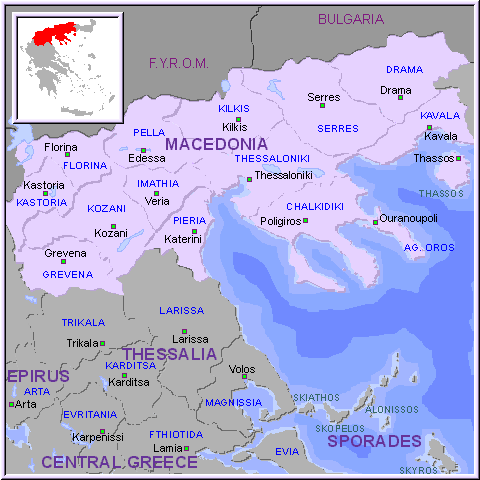
Florina. It was a matter of stuffing my things into a knapsack – it turned out to be 65 pounds of knapsack - putting on my combat boots and heading for Florina. I appeared there and the commandant of the post looked at the orders and looked at me and he looked at his subordinates and said, “what am I to make of this?” So it was arranged according to the orders that had been cut; they said very firmly that wherever I was, I would have to find the nearest large village and report to the proedros [boss man]. I had a stack of police records THAT high by the time I was finished. And I would go in and the proedros would find me a place to stay or put me up in his house. On one occasion I stayed in the jail because it was absolutely empty and it was the only clean bed in the village.
 That most have been very difficult because you did it alone.
Completely alone. I really spoke very good Greek by the end of that. When you’ve been thrown on your own resources as thoroughly as that…it’s one of the loneliest experiences, to fall back on a five-year olds vocabulary and to be able to speak nothing else. After three weeks I got back to Florina and I just stored most of my stuff in the 5th class hotel I was staying in and took the bus back. By the time I got to Larissa [train station in Thessaly], I couldn’t speak a word of Greek – Greek had just faded from my mind. The bus was of course delayed, the buses were always delayed. I got back late, late, late to Athens and I came up here to the School feeling JUST absolutely desperate and got into the area surrounded by the Loring Annex, sat on the steps by the porch, and a late night wanderer came in intending to go to bed. I grabbed him like the Ancient Mariner and talked English to him for about an hour and a half. I’ve often wondered who that was.
You didn’t know him? I don’t know who it was. Then I finally let him go to bed and all my Greek had come back. That’s all it took! So I went down and stayed in a
pandoxeion [hostel] in Plaka, 8 beds in a huge room, and was able to start out again fairly soon. The second tour, the five or six weeks following that first run, that was wonderful stuff, just wonderful.
Afterwards did you write it up? I wrote a paper. I’m not hugely proud of it now. It’s up there [in the library] on file.
What kind of Medieval stuff did you find? Practically nothing Medieval. I did find the largest, ugliest official Roman border inscription in the whole of western Macedonia, which now has pride of place in the Florina museum.
Wow. So you found the inscription, went back to the museum to tell them, and they went to get it? That’s about it. And if you did that sort of thing nowadays, you’d be jailed for it. I committed illegal excavations. Oh, so it wasn’t just laying around on the surface? It was serving as the doorstep of the right-hand chapel of an utterly ruined church, halfway up a hill in western Macedonia. So I levered it out again and after I’d read enough of it, I thought, “hey, this is very interesting!” So very dutifully I made a squeeze of it, but it was cold and breezy up there and the squeeze wouldn’t dry, so I pulled the stone a little further away and made a fire and dried the squeeze in front of the fire. And then I went down the hill to the cafeneion [men’s coffee shop] and said I found something up there at that ruined Chapel So-and-so, which I think might be of interest. And so next day we went up and collected it. I was glad to see, many years later, that there it stands in the Florina museum. Ugliest letter forms I think I’ve seen in my life.
How did traveling around Macedonia affect your dissertation? It gave me an abiding interest in Macedonia. My dissertation had nothing to do with where I traveled, except that I had some sense of how much opener and wider-spaced Macedonia was. If you think in terms of lower Greece, you really miss it – especially after western Macedonia where there’s not much limestone. It’s just a different landscape.
Once you were done with your dissertation, what did you do after you graduated? Managed to talk the Archaeological Institute of America into giving me an Olivia James traveling fellowship on which I traveled. Oh, no, first I got the American Center [fellowship] in Egypt to do Byzantine roads in Cairo. Again, I, in Egypt – a lunatic! [Byzantine roads in Cairo] -the sort of thing that if you’d lived 50 years in Egypt you could probably hallucinate yourself into thinking you had traces of something to work with. But there I was in Cairo and I learned much better Arabic and did the Arabic sources for one of the American-Egyptian excavation projects.
Did your interest in topography develop before you came overseas because of your advisor Pritchett? I must have had it already or I would not have taken to Pritchett as completely as I did. Maps and topography was just IT. Were you able to traipse around the countryside with him? A couple of occasions I got to traipse around the countryside with him, it was an absolutely exhausting experience. This man at age 60 could go up a hill effortlessly, just moving his legs smoothly, and you’d come up behind him, eyes starting from your head. It was just astonishing! And he really did so much believe in getting on to what looked like the site and looking around and seeing, “can you make any sense of the landscape given the events that are recorded about it?”
Did you always carry your Pausanias and Herodotus on these escapades? Gene Vanderpool was the one who’d be certain to do that. We didn’t have reasonable Xerox facilities at the time, so I’m not sure what we carried around.
What was it like coming back to the School as a Whitehead professor? It was very much later and I didn’t expect it to be anything like what I’d known. In fact, I was pleased to see how much it WAS like the School I remembered. There was a long hiatus there when I got more involved with Arabic and Turkish and didn’t really get back to Greece very much, and then it opened up again. That was a real delight. I’d prepared myself for a real change, and of course there was a change, but a lot of the best things were still there.
'Poison ivy,' a #1 single in 1959.
What was America like when you left and when you came back, what major events were occuring? It was coming out of the ‘50s, which were not nearly as torpid as they’re sometimes described. In fact, Theo and I looked at an evaluation of the 50s about 15 years ago and we looked at each other at the end and said, “Well, I guess the 50s really were like that, but we just weren’t living in it. ‘59-‘60? So of course the Kennedy campaign was going on while I was slogging around the fields of Macedonia; it was a very nebulous experience for me.
We’re lucky that we have TV so that we could keep up with the news back home. Did you have to rely only on the papers? Yes, through the papers, or the BBC if we really cared that much. I think there was an American armed forces station around there too, though I can’t remember every clinging to it.
This year we had the Obama Campaign, election and the economic crisis – dealing with events at home while overseas is part and parcel of being at the School. Were you here in the 60s when all the crazy events were going on back in the States? No, I left in 1961 and it was a long time before I came back again, except to Macedonia. I was invited to give some papers at the Society of Macedonian Studies in Thessalonika. That’s when I got to do a walking tour from Thessalonika to the Turkish border. That was wonderful. This latest trip when we went to the same area [in November], I kept thinking, ‘How on earth did I do that?” I would take local buses to a certain area, walk out, study it, come back, and wait for the local bus back in.
Can you tell me more about Vanderpool as THE professor at sites? What he would give was not quite a lecture but marvelously entertaining. He used to say regularly that your purpose here is to study Greece – ALL of it. And so those few of us who did move out of the classical world got a deal of help from him. Vanderpool was beyond description. Very thin, gaunt, energetic…a splendid man.
Was there much interaction between the ASCSA and the other foreign Schools? Colin Edmonson and a friend in the French school tried to form a society of secretaries of the foreign schools and a sledgehammer landed on their heads – it was an organization of foreigners, unpermitted by Greek law. So in fact there was very little opportunity, even with the British School [across the street]. I think there’s more exchange with the British School now then there was then.
Were there public lectures at the School as there are now? Oh, not nearly as many. It was so inconvenient setting them up because [Loring Hall] was the only place they could be held. It meant a great deal of carting chairs around and completely messing up the dining hall, which then had to be straightened up afterwards. Cotsen Hall has made a profound difference in that.
What about the School traditions that we have now, like tea hour and ouzo hour? Tea and ouzo hour were both there. Dinner was still at 8 o’clock.
Was most of the furniture the same? Yes, an awful lot of it was. It may feel that way and it really was. I think that orange thing with all the broken springs goes all the way back to 1959.
Lucy Shoe Merritt said that when she came they had butlers. Any butlers in your time? Oh no, that would have been pre-World War II. Everything went downhill very fast after the second world war.
How was the food? It was changeable. Sometimes good, sometimes bad. I think the after lecture cocktail parties were great. There were crisp, spicy meatballs to die for. I used to fill up on them.
Do you have any favorite stories from your time in Athens or out on the road? In Loring Hall, not much. As a student here, one was not around that much of the time. I wasn’t going in the same direction as most of the other people, which did some funny things to the kind of conversations we would have; it was the time that
Mabel Lang said no three of us were ever having the same conversation with each other. The Macedonian trip? I have so many extraordinary memories of that. One wonderful period of about three days…there’s the big
Lake Prespa that sits over the join of the three borders of Albania, Yugoslavia and Greece – and then below it there’s a little tadpole shaped lake called Little Prespa which is divided from big Lake Prespa by a sand spit.

Lake Prespa, Macedonia.
At the west end of the sand spit, where it leads into a tiny, little, isolated part of Greece, there was a military encampment, a part of the military control zone. And so after I left
Aghios Germanos, I went over to the military encampment to decide if I was going to infiltrate that little isolated area – I did not in fact decide to do that because there would have been no place to stay up there . I wasn’t supposed to take a camera in [to the military zone], but everyone had a camera, you just didn’t advertise it all that much. The soldiers all insisted that I take their pictures, which I did. I used to do my wandering around in the day and when I came back to barracks the conscripts would at nightfall turn their radios to an open channel, where all the border detachments all the way across the north border of Greece fed into the same channel. The [detachments] would sing to each other. They were still very much singing their local traditional songs. The Thracian would wail these long lugubrious wails, the one from Epiros would do very martial sounding stuff. It was wonderful. Did you learn any of the songs? No, they were too much based in the local culture that each of them had come from that were usually totally unknown to anyone outside that province of Greece.
And then there was the time I got my feet washed. At the other end of the spit, at the town that was taken over by
Pontic Greeks in the population exchange, there was a magnificent family of successful Pontic Greeks and [head of the family] was proedros, of course. He decided to take me in and we sat out in the plateia for a while – I had the fascination of watching a mosquito go across his forehead, back and forth, back and forth, trying to find a place where the skin wasn’t too tough to get in, and just giving up at the end! We had a discussion about where I lived and I said I couldn’t describe the house because my parents had moved. “Oh,” he said, “they’ve gone to a bigger house.” “Well. actually no,” I said, “they’ve gone to a smaller house because that’s what they wanted.” His face went blank and then lit up, “Oh, closer to the plateia, eh?”… “Yes, yes, that’s it.” And then we went back to his house and the next thing I knew I was being ushered into the back room where his 18-20 year-old daughter was to wash my feet, the feet of the weary traveler. That was quite an experience, because I tend to be kind of tickle-ish and the one thing I was NOT going to do was laugh at this girl who was performing a centuries old ritual. So we got through that and I got through the suspicion with which I was regarded by the young men who felt they were eligible and didn’t want this prize taken away from them. When I left, I left on the bus with one of them and he explained to me that he was in pursuit of the very lady, but he didn’t think he had much of a chance because “
O pateros tis einei malista pasas” – “her father is a real
pasha.”