Showing posts with label religion. Show all posts

Tuesday, June 25, 2013

Heirloom Archaeology: The Yard Edition Pt. 2, St. Francis

When I grew up, I assumed everyone had a St. Francis in their yard. We had one. Others in my family had one. When I asked who he was and why he was there, I was told that he protected and encouraged happy wildlife, that he would bring bounty to our little garden. He brought good luck to the yard and the squirrels and the morning doves.

Garden statues of holy figures are a tradition especially loved by Catholics. The concept and general idea behind them will be familiar to those studying ancient shrines for nymphs and other locally sacred beings.


In our family, St. Francis is the dominant garden statue and his presence can be traced to one particular image. It's the most 'sacred' in the family because its the oldest and it reaches back to the elder generation's childhood. It's been through hurricanes and moves, has been broken and reassembled, but somehow its still standing. It's the talismanic Athena Polias of the clan.

The statue of St. Francis has lived in the garden of the ancestral home's courtyard. The courtyard itself has gone through numerous changes over the years. Back in the day ('50s) there was even a palm tree in the middle.


This is where the grown ups sipped their cocktails: Myrtle Rask (my grandmother) and Anna Mae Sirl (great-grandmother).

But St. Francis was there, his toes in a bird bath, surveying his domain. He spent the years encouraging all the tropical plants to go wild, watching over the tiny lizards zipping across the patio, and providing a perch for song birds come to raid the bird feeder.


Analysis of the photographic evidence shows that nowadays St. Francis is in almost the exact same location, with some of the exact same plants still thriving under his protection.

St. Francis in 1958.


Best of all, he's still protecting the little animals :)


Wednesday, May 5, 2010

Take only pictures


Lately I've really been interested in the idea of 'place' in religious practice. My pal Beth Shively and I have spent a lot of time talking about 'sacred' landscapes in America (or the lack thereof), and our conversations have been rattling around my head quite a bit. Last week I witnessed one aspect of the American approach to our landscape when I was hiking the awesomely-named Fiery Gizzard Trail in southern Tennessee.

The forest was all lovely and green and breezy. Now, in antiquity if you wanted to go hiking, you just attended a sacrifice, joined a religious procession or climbed up to some Cave of the Nymphs to unload an offering or two. Nowadays we like to 'hike' and 'enjoy nature' for its own sake. Our national parks are secularly 'sacred' simply for existing; they must be preserved in their virginal and pure state, kept undefiled. Yet, other peeps enjoy the landscape just as much as we do, but their interaction with it is incorporated into their religious life and mythological histories. Going on a pilgrimage neatly solves the basic human desire to get all holy, visit some tourist sites and get exercise. It's like the ancient Athenians taking a 12-mile hiking and camping trip to Eleusis, ostensibly to get initiated into the Mysteries of Demeter and Kore. But, really, in my reconstruction, that whole religious procession with its sacredness thing was also about swimming at the beach, finding the perfect walking stick, and eating s'mores.


While getting my Fiery Gizzard on, I fondly remembered hiking in Greece. If I'd been there wandering the countryside, instead of the Cumberland Plateau, I'd have come across like 17 shrines along the way, dedicated to various saints and multiple versions of the Madonna. My Tennessee trail had no such shrines. I wonder if I should go set one up just to see how fast the National Park Service would remove it. Take only pictures, leave only footprints...and votive candles. And good luck charms. And sacrificial chickens.


Of course, not all the US is a religiously barren wasteland. There's always the Mormon landscape or the sites of Catholic epiphanies of the Madonna. Just a few weekends ago I got to visit one of the most impressive native religious sites our country has to offer, the Newark Earthworks.


They were built by the Hopewell Indians at about the same time Julius Caesar and his boys were tearing up the Roman Empire with their civil war. The mounds were huge. And impressive.


Recently I saw an author speak who was attempting to emphasize the American landscape in his YA fiction. Most of us have grown up on Narnia and Middle Earth and Westeros, fantastical worlds based on European landscapes. This author said that he wanted to make our own countryside - Midwestern cornfields and southern mountains - just as full of wonder and magic and possibility as any mystical Irish loch. I dig that idea. I think it's time we stopped worrying about the musty, fussy Old Country and spent a little more time fixating on our own lands. Who needs Bethlehem when you've got Fiery Gizzards, after all?

Friday, July 31, 2009

Ursula K. Le Guin's Popular Religion

I recently had to drive 9 hours up to Columbus, Ohio. The drive itself wasn't too bad. Books on tape, a new favorite hobby of mine, always make the trip go faster. I had checked out a new trilogy by Ursula K. Le Guin, the 'Annals of the Western Shore,' published between 2006 and 2009. Not only did it seem like an interesting listen, but I thought I'd steep myself in some more Le Guin before I read Lavinia.

It was during the trilogy's second book, Voices, that I saw how steeped Le Guin had become in Roman history, no doubt part of her preparation and inspiration for Lavinia. The city of Ansul, where the novel's action takes place, is very much a Roman city, with its libraries, colonnaded buildings and marble-paved floors. Socially and politically it looks the same, with echoes of a patronage system, Great Families and epic poems recited in the forum. Le Guin's Ansul, having been subjugated by an invading force, now remains only an echo of its former self, half empty and broken, waiting to throw off the yoke of its invaders. The enemy force that had sacked the city - burning, looting, raping, drowning books in the city's canals - are called the Alds, a name that, when said out loud, sounds very much like 'Gauls'.

But these Alds are not just barbarians with different colored hair and strange manners of dress - they are also the book's equivalent to Muslims, with only one god (worshipped on prayer mats), an abhorrence and hiding-away of women and a holy war to boot. I would have hoped for a little more subtlety from Le Guin when it came to their depiction, but I think perhaps her intended teen audience required a blunter and more obvious association to modern goings-on.

Although the Battlestar Galatica-esque contrast between monotheistic and polytheistic cultures was a bit heavy-handed, I especially enjoyed Le Guin's depiction of the religion of Ansul. It is very much Roman popular religion, sans the public and state-rites that we mostly hear about. In fact, Ansul has no priests and no temples, only domestic shrines, street-altars, god-niches, and sacred stones.

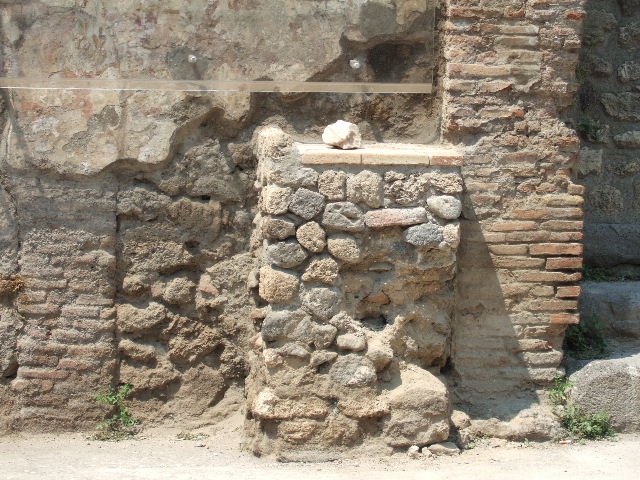
A compitum (a type of neighborhood street-shrine) at Pompeii, from one of my favorite websites, Pompeii in Pictures.
Whenever dire questions need answers, the Cave of the Oracle is consulted and the answers written on the air. Every morning, the members of the family move about the house leaving various offerings - leaves, flowers, a touch of the hand - on the many shrines and niches. The worship of the family's gods and ancestors is the most important of all.


Painted lararium (private shrine) from Pompeii's House of the Vettii.
When the main character, Memer, is asked who her gods are, her litany sounds particularly Roman (with a bit of Hindu thrown in). She responds, "My gods are Lero; Enu Who Makes the Way Easy; Deiory Who Dreams the World; The One Who Looks Both Ways; the Keepers of the Hearth Fire and the Guardians of the Doorway; Iaina the Gardner; Luck Who Cannot Hear; Karan Lord of the Springs and Waters; Sampa the Destroyer and Sampa the Shaper, Who are One; Taru at the Cradle and Anada who Dances on the Grave; the Gods of the Forests and the Hills; the Sea Horses; the Soul of My Mother... and the Soul of [My Grandmother] and the Souls and Shadows of all Who Have Lived in this House, the Forerunners Who Give us our Dreams; the Room Spirits, my Room Spirit; the Street Gods and the Crossway Gods; the Gods of the Market and the Council Place; the Gods of the City and of Stones and the Sea and [the Mountain]."*

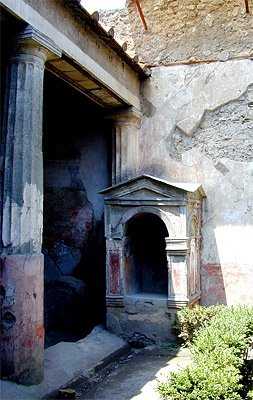
Courtyard domestic shrine from the House of the Tragic Poet at Pompeii.
When I listen to the book, all I see in my mind's eye is Pompeii. The novel has been a pleasure to listen to, not only because Le Guin is a masterful story-teller, but also because she so effectively awakens Roman popular religion, highlighting the interaction that normal people had with the gods on a daily basis. I am interested to see how Le Guin will portray the religion of 'Archaic' Italy in Lavinia, and especially looking forward to her rendering of Etruscan culture and religious practice.


Charu and Vanth, Etruscan psychopomps, here guarding the Hellenistic-era Tomb of the Anina Family.

We're lucky to have Le Guin, I think. It took me a while to get to her books, but she slowly grew on me with each one I read. I'm of the opinion that she is rightfully considered one of the Master's of the Fantasy/Sci-Fi genres, and I can't wait to see her approach to historical fiction and to Vergil's epic poetry.

*This transcription comes from the book-on-tape and therefore has incorrect spelling. Nor do I have a page number, but it's from Chapter 9.

Monday, October 27, 2008

Religious Visual Art in Konstantini: Iconography and Blasphemy

I study dead religions. They’re fun. But I still see and think about living religion all the time. On the trips, we’ve randomly seen a great deal of interesting things relating to religion in practice, and so I thought I’d make a few posts over the next few months on the more noteworthy or quirky or freaky things we’ve come across. I’ll start with one of my favorite works of religious art here in Greece so far.

During Trip II, we visited a small church in the town of Konstantini because it had a very important Lex Sacra built into the wall of the entrance. Dan Leon gave his site report on the ancient decree (from Andania), which has some very valuable information about ancient Messenian religion and mystery cults. Besides the ancient stuff, one of my favorite things was this picture, framed and hung on the door of the small church. The text accompanying the image says basically: “Don’t Blasphemy.” It details all the horrible things that will befall those who do so.

What I especially love about it is the iconography. What does it tell us about blasphemy and those who practice it? Here’s my art historical approach to the pic. First, let’s see what it actually shows. Jesus hangs upon the cross. At the base kneels a soldier, hands clasped in prayer and head bowed, eyes closed. His gun has been laid at his side and his helmet rests before him – he seems to have come straight from the Front. He has short-cropped hair and is clean shaven. As a soldier he is a brave young man defending his people from evil; he is pious and correct, humble and thankful. But behind him is his mirror opposite.

Another young man, decked out in the latest fashion, moves towards the peaceful scene. He has long hair and enormous side burns. His pants flair at the bottom. His demeanor is loud, he struts about, his head is raised defiantly towards Jesus, rather than lowered as it presumably should be. He looks like a spoiled city brat, a late night drinker, the kind of man who hangs with less-than-demure women. He clearly lacks any discipline whatsoever and wastes his time doing frivolous things while the humble soldier does his duty. The contrast between the two could not be more pronounced. The townie’s words, blasphemy physically aimed towards the cross, spews out and up - but it hits an invisible barrier just at the location of the young soldier, leaving him and his god in a protective bubble. The blasphemous words bounce back towards the upstart, changed into rocks (my favorite part): he is condemned and stoned by his own words. The serpent creeping up behind him is either egging him on or it is waiting to consume him when he turns away from the salvation depicted before him.

It’s fantastic. As a composition it is split down the middle, the townie upstart and the serpent on one side, the pious soldier and Jesus on the other. It says a lot about rich kids that don’t serve their country when they should, and the assumed devoutness of soldiers. It contrasts rebellious fashionistas with those who wear modest and drab uniforms. It contrasts silent prayer with loud voices. It contrasts gi-normous monster snakes with the culturally weighty symbol of Jesus on the cross. Its message could not be more clear.

I wish I knew when it was made. The picture elevates blasphemy to a mortal sin, while reflecting that old dichotomy between the two stereotypical kinds of young men. What a totally brilliant picture. Love it!