Monday, May 18, 2009

In which Katie identifies a scapula

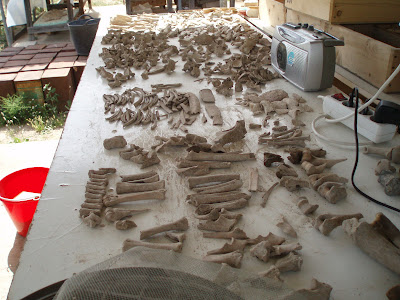
Medieval bones.

One of my main academic areas of interest is the archaeology of sacrifice. For this reason, I have always been very interested in, but very daunted by, excavated bone material. Luckily here at Corinth the 'reading' of bones takes place in earnest, thanks to Thanos Webb, the bone dude.

Thanos Webb, rocking the osteological evidence.

Every day, along with our pottery, we have to get our bones 'read.' Basically, that means that Thanos the bone guy looks at every bone we pull out of the ground, identifies it, weighs it, describes it, etc. His information goes into our context database. As with our pottery, we are expected to 'sort' the material, grouping the bones together by their anatomical part and, if possible, by animal.

Marty Wells, my trench co-supervisor, sorts bones last Saturday.
Before getting here, I had no bone experience at all. And I mean nothing - no anatomy class, no games of Funny Bone, nothing. I had no idea what the difference was between a humerus, a tibia, a femur, or a radiaulna. Well, it's finally making some sense, after three weeks of sorting bones into little piles, day after day. I am full of that proud sense of accomplishment you get we you learn something new, and you desperately want to run around and tell everyone how smart you now are. Suddenly I actually understand what a metapodial is, or the atlas vertebra, or some other crazy bone stuff. You know, basic anatomy.

I have been aided in this endeavor by the well we've got in our trench, as it's vomiting up an enormous amount of pottery and a ton of bones. Today I sorted our largest bone context yet:
That's the last of the big guns for this session, but I still have to look forward to a day of sorting itsy bitsy bones, egg shells and fish scales. That might actually stretch the limits of my nerdy excitement, however.

Friday, May 15, 2009

Our well

It occured to me that I haven't really mentioned much about what we're doing out in the field here at the site of ancient Corinth.


I'm in the Blue team, and our trench has a well in it. We've been excavating the well for several days now, and currently we're at a level about 8 meters deep. The amount of bone material and pottery coming out of it is a bit staggering. The best part, though, is going down to the bottom.

Because it's so deep, we've had to set up a platform and winch to both lower people down and haul dirt out.


Alicia Carter, the field supervisor, heads down into the deep, dark hole.

Thursday, May 14, 2009

Interview with Pierre MacKay: Part 1

On April 3rd, I interviewed Pierre MacKay about his experience in the Regular Year program. He did the program in 1959-60, which makes it now the 50th anniversary of his year. I met Pierre at the beginning of my own Regular Year, when he came on several of the trips with us. He was full of information about the later history of Greece, such as the Frankish/Venetian/Ottoman periods. He was also great to have around because of his interest in topography, learned from Kendrick Pritchett, whom many view as one of our field’s greatest topographers.

During this interview, I learned several things. First, my voice and laugh sound ridiculous on tape. Second, I am incapable of speaking in complete sentences. I suddenly have new respect for all those people who do interviews on TV (although I still think Larry King sucks). Third, I learned that transcribing spoken words actually takes a lot of time.

So what follows is the first portion of my discussion with Pierre MacKay. If I am guessing correctly, there should be about three sections more to come, although it may turn out to be a bit longer in reality. In the first part of our talk, I tried to focus on the basics of the Regular Year experience, such as the living situation, the food, the professors, and the trips. Fortunately, Pierre is really a great story –teller and it was a total pleasure to hear about his experience.
Enjoy!

Pierre MacKay (photo by Dan Leon).


How did you hear about the Regular Year and how did you know you wanted to do this program? I was at the University of California studying largely with Kendrick Pritchett and there was no way you could not hear about the American School if you did that. So he talked about it a lot? Oh yes. Did he require that his students come over? Kendrick wouldn’t put it quite like that, but no one would stay with Kendrick very long without developing that passion.

What was the application process like? I remember a 3 out of 4 exam application…I do recall that the interesting part was that for the first time I ran into Hellenistic Greek and Hellenistic history, which was a real eye opener that I was not adequately prepared for. Fortunately, I had taken some interest in the Hellenistic age, so I could pretend some of it.

How did people fund an entire year in Greece? There were, I don’t know how many full or large-scale maintenance fellowships, but I came on a Fulbright. It was one of the rare instances where a Fulbright could be taken associated with an institution that was an American institution. Usually the Fulbright required that you moved into a foreign institution.

When you came over, what was the trip like, where did you fly into? Fly?! I came by ship. How long did that take? I think about five days. Did everyone come by ship? No, I came by ship. I can’t even remember the name of the ship, was it the Olympia? It was one of the last transatlantic liners that Greece ran. So you came into Pireaus. Did you take the train up to Kolonaki? Well, we were met by the Fulbright Committee and there was a good deal of chaos immediately following, and an orientation in which the head of the committee effectively said, “Welcome to Greece. Don’t eat the food.”

Was it the first you’d been to the American School? Oh, absolutely. And did you live in Loring? I lived in Loring at the far end of the first floor of the annex, there’s a suite right beside the bathroom that was one over from mine. And I kept telling myself and I still want to believe that that was the same place Kevin Andrews stayed.

For that year, who was the Mellon professor? There wasn’t a Mellon professor, there was the THE Professor of Archaeology, Eugene Vanderpool. How long had he been THE Professor? Eugene had arrived sometime in the 30s, I should think. It’s not very clear, according to what I used to hear later on, what he intended to do, but he just absolutely fell for Greece, had the great good fortune to marry money, and just became a virtual Greek here, which made his position quite secure because the School didn’t have to fund very much of it. The School was not much given to funding things. [*Note: The School was in financial straits at the time.]

Did he live here all the time? The Vanderpool’s had a place in Pikermi. They kept themselves to themselves, very much outside the world of the School. I’ve never seen the place out in Pikermi, one or two special students of Vanderpool have, but basically both he and she wanted to have two separate lives and this was respected.

What was the area around the school, Kolonaki, like in 1959? Not horrendously different then it is today, but with a lot less glitz. There was a wonderful old cafĂ© call the Byzantium on the downhill corner of the present plateia. It has the distinction of being one of Melina Mecouri’s hangouts. By ‘59 were all these buildings around Loring the same? There was not much open territory surrounding the School by 1959. The pressure of the Civil War had just totally altered building space in Athens. Things were just going up all the time.

How was the year organized? This was Henry Robinson’s first year and my sense is that Henry expanded the program and its present form owes a great deal to him. We we’re still close enough to the Civil War that transportation in some areas was pretty iffy. We went up to Delos first and I guess that was tried a couple of times again, but it’s been dropped [from the program] because if the weather suddenly changes there is nothing you can do about the schedule, if the boats aren’t leaving you’ve lost the schedule for the rest of the year, so I understand exactly why they dropped Delos. Delos was rather limiting, but it was an interesting thing to have done. And then came Central Greece, and then the wonderful Northwest Greece which was with Eugene Vanderpool (one of his specialties) and Colin Edmonson, the School Secretary, both of them just loved that area, and we went around on trips so that some years ago I said that the striking thing about Henry was his over-optimism about what Greek buses could do on Greek roads in 1959.

What was the transportation issue like? It was fairly limited, not hugely luxurious tourist buses and we had our own special driver, a sardonic man who was extremely amusing and a terrific driver. So there was no riding donkeys up to Bassai or anything like that? No, the School couldn’t afford that kind of indulgence. When we ended up doing the Peloponessus we did the wall over the Lykaion Zeus, up from Bassai, over and down to meet at the bottom of the hill, and on to that Arcadian goddess’s [sanctuary].

Was it just Eugene Vanderpool leading the trips? Henry was indefatigable. Henry, in the first year I was here, Henry managed to run the school, lead a couple of trips, be the director of the school AND the director of the Corinth excavations. By the summer, that involved hair-raising trips up the old Kakiscala road in a large Landrover as he came up at the end of the week to do the schools business and roared down again to get back to Corinth. Henry was extraordinary.

What were the conditions like out in the countryside? You weren’t that far off from the Civil War, so how dangerous was it? There’s always rumours that the Regular Members had to carry guns back in the day, did you have to worry about things like that? It was too late for that. I came right up on the edge of [the Civil War] on my Spring Project, but that was because I went right up to the north-east corner of Greece and was wandering around back trails and the Civil War had only ended in ’57 there. The smell of gunpowder was still very much on that landscape. Did you have any run-ins with anybody there? No. I went through some villages where it was perfectly clear that whatever side they’d been on hadn’t won. So there was a lot of damage throughout the landscape? A lot of damaged memories – less damage then you might think, but a lot of bitter, damaged memories.

[Before your Spring report in northwestern Greece,] you did the trips in the fall – did you have site reports you had to give? Oh absolutely! What were your site reports? On Delos, I had to give a site report on the Egyptian gods which was pretty good because I knew nothing about either, but that’s what the site reports are supposed to do for you. In Central Greece, I was given Hosios Loukos; I was the token Byzantinist that year. I can’t remember what I did for – oh, I did the Arta Church for the Northwest. And for the last part, the Peloponessus, I can’t remember – but I loved that trip.

What were the site reports like then? I've heard that back in the day everyone would give three hour site reports, which included every single detail that they had come across when researching. Is that how it was for you? That was probably Bryn Mawr students who had gone through Machteld Mellink’s [the ‘mother’ of Turkish archaeology] seminars! Machteld Mellink would allow anyone to go on and on and never stop them, and afterwards say, ‘You know, you can’t use footnotes in an oral presentation.’ I probably shouldn’t confess this, but one night when Henry Robinson’s over-optimism had resulted in what we called ‘Temples by Twilight’ and it was getting pretty cold – we were at Eretria – one of the students, who wasn’t even really in the field but had enough money to come to the School, started in on a report by flashlight and we sat there listening to page after page of it, with all the footnotes and all the graphs and so forth, and I looked to the side and could see that there was a great heap of paper there, and so with a wink to the rest of the group, I slipped great chunks out of the heap of paper; he still got down through his notes and the lack of continuity didn’t faze him the least. This was more or less the attitude back then, it just went on and on.

Can you elaborate a little more on this ‘Temples by Twilight’ notion? Well, it was the inevitable result of making plans on the grounds that nothing would go wrong, pushing the Greek tourist buses and the road conditions to their absolute limit, and when something like getting mired in a dirt road halfway across the Kopaic basin slowed us down, problems arose. But we’d keep going. Henry never gave up on anything. He was a wonderful man.

What were some of the temples you saw by twilight? Well, the report that was being given at Eretria was, I think, being given about the Macedonian-style tombs at Eretria and there wasn’t a lot to see because we weren’t allowed anywhere near them. I remember Sounion was a temple by twilight. That must have been awesome. It had its moments, but it was COLD! It got really quite cold sitting on the ground with the sun down. And I can’t remember what else, but Sounion and Eretria really stick out.Would you guys get grumpy about having to see things after dark? Oh god, yes. We were the best gripers. We were terrific gripers.


What was the food situation like? That was pretty interesting. The evening food was usually up to us to find. We were staying usually in third class hotels but quite often fourth. My own feeling was that fourth class hotels were cleaner than the third class ones because the third class hotels didn’t think they had to bother. If there was enough hours of daylight (or twilight) at the end of the day, the ladies were assigned a picnic party and they would go out and buy tuna, bananas, oranges, bread and so forth, and anything that we had deigned to suggest might be a good idea. So we had a mass picnic made up of whatever Ione Shear and Theodora Stillwell had found that was worth buying. And then breakfast in the morning: tea a good deal of the time, Nescafe otherwise, eggs usually (hard-boiled), some kind of toast…fairly thin fair. It was laid on a central table – buffet breakfast rarely happened then. Occasionally we would have lunch in a hotel. My favorite was the Altis Hotel in Olympia, which was one of those old, old places that are gone now. Huge high ceilings, a great big table in the center of the room, and the lunch would be prepared for us, usually watery soup followed by watery spaghetti, full of watery beans. And just to show that they were very up on hygiene they would climb up step ladders and flit [spray] the ceiling, approximately an hour before we came in for lunch, just about the right time for the groggy, dying flies to drop off the ceiling into the soup bowls. It was an interesting experience.

What was the dress code? Was that the time when women still had to wear skirts? All too often, all too often. Yes, I don’t think I ever saw a pair of slacks. What about the guys? Was it all jeans and t-shirts or did you ever have to look fancy? Out on the trips, certainly not. But [back at the School] we had royal receptions, when the king and queen would come over for a reception on the upper floor of the School. I talked to Constantine while he was still Prince Constantine. About what? I guess about my traveling around in Macedonia and he said, ‘Oh those are rough people up there, there’s a lot of sheep stealing going on.’ And I said, ‘Many of my ancestors were hanged for the same crime.’ I don’t know if he really got it. But they were a very easy going lot. Pavlos was quite impressive. That family had NOT been made up of diplomats to any great extent, but Pavlos put the lid back on the kettle and allowed enough stability for the Karamanlis reforms, and they really were reforms, to go into effect.


Recent research has discussed artists coming through the School. Was there anything like that in your Regular Year? I think that was before WWII. I recall some people who were interested in modern art visiting briefly, but it would be a difficult environment for someone with those ideas primarily in mind. Who do you talk to? It’s not the American Academy in Rome [where people with both modern and ancient interests come together], yet it has its own strengths. It has an inherent loyalty that develops even with all the crabbing we do about it – I’m not sure any of the other Academies have anything like that. Perhaps it’s partly being forced onto the bus for three months during the Regular Year!
~ Read Part 2 of the interview here ~

Tuesday, May 12, 2009

The Corinth Kennel

Many houses in Greece are surrounded by low walls that form a sort of compound. Such is the case at Corinth, where the dig house is surrounded by head-high walls marked with a few serious looking gates. Inside one finds a rather spacious yard.

Anyways. The first thing that one notices upon entering the compound is the sound - growling, yipping, barking, scrabbling paws and clicking toenails. Yes, its the dogs of Corinth, here to brighten everyone's day.

There's Floyd, the black dog with the brushy tail, who has been raised in the ways of dog parks and is thus an expert in playing, wrestling, chasing, and gnawing.


Then there's Mata, the recently adopted stray from the excavation site who lived in the trenches and melted everyone's heart with her blue eyes and oversized paws. She follows Floyd around and tries to emulate him in every way, like a little sister with a big brother.


Harriet is just a year old and bounds about in exact imitation of a hare. Speaking of hair, hers was shaved off today, so that with her shaggy head and completely bald body, she looks to be straight out of Dr. Seuss.


The bosses of the yard are Charlie and Norma, the terriers belonging to the Dig Director. They're loyalty is legendary, such that this last weekend when Guy Sanders went to a conference, his two pups staked out the gate and stared at it for three days straight, giving disappointed looks to everyone else who entered. They're fierce, too - Charlie recently killed a snake that was about a meter long, right in front of a tour group of undergrads. Said snake will soon be a trophy of sorts, currently being defleshed for the bone study collection.


That's five dogs. That's a lot of playing fetch, chasing eachother pell mell, digging extremely deep holes, arguing over bones, running back and forth, wagging tails and sideways grinning. As has been said on more than one occasion, they make for constant entertainment, a sort of 'dog-tv.'

And of course, if you plan on jogging up the side of the mountain but think that it might be unsafe to go alone, there's always Sadie Saddleback. He's a super friendly street dog who plays with Floyd on site and hangs out at the pottery shack. Sadie is happy to accompany you trailblazing and asks in return only a bowl of water and a single doggy treat. What a gentleman.

Wednesday, May 6, 2009

Syrup, of one form or another

I've been in Corinth the last week and a half so I have a been a bit slow on the blog front. I have some ideas banging around in my head, but need time to actually write them out. Plus, I am STILL transcribing an interview with a member of the 1959-60 Regular Year.

I'm here participating in the Corinth excavations, where we are working on a Frankish/Byzantine area of the site. The days are long, which leaves little time for thinking hard about anything other than deposits, fills, cuts, wells, robbing trenches, foundations, etc. And I'm not joking - I'm having freaky archaeological dreams every night.

There's a lot to learn about the history of Corinth and the excavations, much of it institutional, but more of it as 'oral history.' I'm working on it, but for now, here's a little story.

Corinth doesn't have tea hour (we have mid-morning snack, instead). Like at Loring, it does have ouzo hour at 7pm:


Ouzo is served, believe it or not, in a Mrs. Butterworth glass bottle.


This is actually a long-standing, 40 year old tradition. Some 15-20 years ago the Butterworth Ouzo Bottle got dropped and shattered - major party foul! A new one was purchased; the one we have now is about two decades old.


Woe to the person who drops this Mrs. Butterworth bottle- they've gone out of print.

Sunday, May 3, 2009

Success with Isadora Duncan

In response to Kostis Kourelis’ call to 'reclaim the city' over at Objects-Building-Situations, my weekend included a quest for the long-ago home of dancer, feminist, hippy-before-there-were-hippies, Isadora Duncan.

In one respect, finding Duncan’s old house had less to do with the house itself and more to do with the act of finding it (insert references to the Odyssey and the ‘journey being more important than the destination’ here). Physically wandering the terrain in search of a place known only from books is practically the earliest calling of Classics as a discipline. After all, from the first we, as students, hear tales of our predecessors traipsing the countryside with a battered copy of Pausanias or the likes of Colonel William Leake scouring Greece in the 19th century.

Topography, the study of place, has been central to our endeavor. But for most people, topography is a foreign idea. After all, why would you walk somewhere when you could drive? For most of us, myself included, my knowledge of the land in which I live is shaped by a framework of sidewalks, roads, streets and parking lots. If there are ravines and dips and rivulets and, most indecipherable of all, mountain passes, I would have no idea. In cities we’re encouraged to stay OFF the grass and in the wilds we’re advised to stay ON the path. And it’s a lot harder to meander through fields and hollows when you’ll get arrested for trespassing. But over the last few years I’ve started to really get an idea of this ‘topography’ thing, thanks to Denver Graninger, John Lee, Tim Gregory and most especially Pierre MacKay.

But my search for Isadora Duncan’s house did not start out in a romantic expedition-y sort of way. Instead, it started with about 5 hours of arguing with the internet, ripping my hair out, and lamenting the useless information highway. But success was at hand, since, after all that, my Google skills had become honed to a fine and deadly point. When I finally set out, it was not in my motley jogging outfit with an ipod strapped to my arm and a playlist at full volume, but with a backpack filled with a packed lunch (trailmix!), water, camera, a map and an address. Unfortunately, it was an address I could not match to the map; there was a period of wandering around, asking directions and feeling lost. But in the end, we did indeed find Isadora Duncan’s house: 34 Chrysofis and Dikearchou, Byron.


So, that should cover the journey part of the story, now here’s a little bit about the destination.


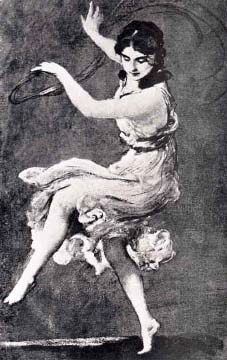
Isadora Duncan was a famous American dancer at the end of the Victorian era. With her brother Raymond, she developed a philosophy of movement that not only inspired the entire phenomenon of ‘Modern Dance’ but also an untold number of artists for whom she was a ‘Muse.’ She was revolutionary in a number of really remarkable ways, whether in her rejection of fussy structured ballet, tightly-bound Victorian clothing, or traditional gender roles. In 1903, Isadora and her brother were obsessed with ancient Greece and travelled there to frolic in ancient garb at the theatre of Dionysius. They decided to be pagans and to create their own utopia. Upon finding a hill that provided a fantastic view of the Parthenon, they planned to build a Temple for their ‘clan,’ modeled on the Palace of ‘Agamemnon.’

Isadora calls the spot Kopanos Hill, claiming that such was its name since ‘ancient times (Duncan, My Life, 93).’ Of course, despite all my attempts at figuring out what her source for this bit of info is, the most I could find, with the help of philologist Dan Leon, was that ‘kopanos’ might be related to the word ‘mallet/pestle’ but has no obvious links to a hill in Athens. It also means ‘jerk,’ ‘asshole’ or ‘prick’ in Modern Greek…it’s a good thing I didn’t go around asking people where Kopanos Hill was - that could’ve been awkward.

After a few years of trying to build a structure on a hill which had no natural source of water, the expense became so astronomical that Isadora (who had been funding the project) had to shut the dream down. She opined, “Kopanos has always remained a beautiful ruin on the hill, since used by each faction of Greek revolutionaries as a fortress. It is still standing there, perhaps as a hope for the future (129).”

Regardless of her nostalgic and wistful view, she came back at the end of WWI with a gaggle of students and the dream of opening a dance school. “We found Kopanos a ruin, inhabited only by shepherds and their flocks of mountain goats…We laid a dancing carpet in the high living room and had a grand piano brought up…with the gorgeous view of the sun setting over the sea…in the cool evenings we wreathed our brows with circlets of the lovely white jasmine flowers that the Athenian boys sell in the streets… (250-1).” For Isadora, dancing was fine, but dancing in the Greek landscape, with its blue sky and ancient marbles, was entirely different. Place was essential. The landscape as a backdrop shaped the dance.


Her relationship with the Greek landscape would end in 1920 when Venezelos left the country in exile, and her with him, as she had been his guest there. What exactly the history of Isadora’s house was thereafter I have not been able to determine, at least not until the story picks up again in the early 1980s. Now the structure’s located in the modern Municipality of Byron (named after, yes, that Lord Byron). When Clan Duncan moved in, it was a barren hill, but presently it’s a packed section of downtown Athens. The Municipality, recognizing that the house had historic value, restored it and turned it into a modern dance studio.


It’s now called the Isadora and Raymond Duncan Dance Research Centre and their website stresses the fact that it’s not just the studio that’s important, but its location - its value is ‘site specific’ both physically and in the cultural memory associated with Isadora and her family cavorting on the rocky hillock.


The mount really does boast a spectacular view of the Mediterranean Sea, but the substantial presence of the Acropolis that was so palpable to Raymond and Isadora has gone the way of tall apartment buildings.


The studio sits upon an open terrace. Although it’s well-cared for, the building is covered in graffiti tags. In an empty lot abutting it and separated by a metal fence, a strange bomb-shelter-like structure hunkers down.


Polished wooden floors gleam behind curtained windows and the website indicates that the studio is active both locally and internationally. In 2003, the Center produced Her Topia: A Dance Architecture Event, a performance meant to engage the modern dancers’ connection to Isadora, to the space on the hill, to the rooms within and to the neighborhood itself. Carrying rocks meant to mirror the blocks that Raymond Duncan carted in to build his house, the dancers moved within the different parts of Isadora’s ‘Temple to Dance,’ then on to the terrace, to the bunker and even to the roofs of the surrounding apartment buildings.


In her own way, dancing across from the Acropolis while the sun went down, Isadora Duncan tried to forge a connection between movement and her surroundings. During her time in Athens she was struck by ancient tragedy, by mythology and by the illustrated visions of maenads dancing on ancient pottery. She and her clan traipsed about, barefoot, looking for boys to fill their chorus and theatres to haunt. It was in the Greek countryside and in the ruins of its ancient cities that she experienced an almost religious connection to an ancient ideal. She found that ideal in a movement and dance that incorporated the surrounding Greek environment, her house upon the hill, and her own human, free, unconstrained manner of motion.

And this is where I bring it back to topography. Isadora, my feminist ancestor, employed topography for dance. My academic ancestors employed topography for history. If you’re in Athens and want to experience a topographical mish-mash of your own, all you have to do is jog from the Stadium down Dikearchou St, up and over a few rises, and you’ll find yourself where Isadora Duncan and her brother Raymond once placed their temple of dance. The much lauded view of the Acropolis is gone, but at least there still exists a mutation of Duncan’s Clan there, moving about on the concrete hillock as the sun goes down, thinking about landscape, buildings and situations.


Calvin Borel rules

Congratulations to Mine that Bird and his jockey Calvin Borel for winning the Kentucky Derby.


HA! Suckers.
Funny enough, I didn't even realize yesterday was Derby Day. But Mine that Bird, the 50-to-1 longshot, absolutely annihilated the competition in a truly jaw-dropping victory. If you missed it, have a look here. The best part of the whole thing was that his win was such a shock, even the announcer didn't realize it was happening and had no idea who the horse was. You can hear in his voice when he has to check his list to figure out who was winning the Kentucky Derby. Totally awesome.