Saturday, June 27, 2009

The Burbs of Athens

For a few days now I have been staying with an OSU contingent in one of Athens’ northern suburbs, Melissia. It borders the more famous town of Kifissia located on the Cephissus River – a wealthy enclave in both modern times and ancient. Kifissia was once the home of that loveable scamp Menander, while also becoming a real social hotspot when the slightly psychopathic Herodes Atticus built his villa there.


Dallas DeForest, Brian Swain and a complete stranger gaze at three sarcophagi, thought to be those of Herodes Atticus’ children, buried by their father. They're kept behind glass, right next to a periptero (kiosk) and amongst all the Kifissia shopping.


Menander: "A rich wife is a burden. She doesn't allow her husband to live as he pleases. Nevertheless, there is one good to be gained from her: children."

More recently, Kifissia has been home to political dynasties and the mansions that they build, as well as a succession of ritzy shops and cafes. It doesn’t have quite the glitz and bling of Kolonaki. Whereas Kolonaki is sorta South Beach, Kifissia feels a little more like West Palm Beach, to me at least. Others might think Cape Cod instead, with its ‘old money.’ The Nazi’s used the Kifissia home of Panayotis Aristophron, who excavated Plato’s Academy, as their invasion headquarters.

There’s not much ancient stuff left to be seen these days, even if you do wander around with a copy of Tomkinson’s Athens: The Suburbs, nicked from your professor’s shelf. The Church of the Panagia, supposedly built with the blocks of Herodes’ villa, is fenced off and locked. The Grotto of the Nymphs, used by women for divinatory purposes up until the 19th century (Tomkinson p.54-5), can’t be found by visitors.


At least, it’s lost to us. Brian and Dallas in Kifissia’s Kokkinara ravine, where we found garbage, dead birds and thorns, but no Grotto of the Nymphs.

It was Melissia, however, that proved to be a much more interesting ‘hood than Kifissia. Although it’s well-to-do, it doesn’t put on quite so many airs as Kifissia. It has shady lanes and plateias (squares), feels like it’s not trying so hard to impress rich people and teenagers, and appears to have a hefty sense of local identity.

Apparently the town was settled by Pontic Greeks sometime in the 20s after the ethnic cleansing in Turkey (I’d be more exact with my details if someone would be kind enough to fix Melissia’s Wikipedia article.) That's when, thanks to the now divinized Ataturk, the burgeoning nation of Turkey felt the need to expel all non-Turkish/non-Islamic elements. This included Greek villages whose ancestors had settled the region as early as 800 BCE – I guess in Turkey at that time you’d had to be around for more than 2,800 years for squatter’s rights to apply.

Anyways, in the 19-teens and early '20s, Pontic Greeks, Armenians and many others were the victims of genocide, were massacred or were forced to leave their homes. Think the ethnic cleansing of the Indian Removal Act or, as we more commonly call it, the Trail of Tears.

So all the Greeks in Turkey had to go back to their ‘true home’ in Greece. A group settled in Melissia, small town at the time, but now engulfed by the sprawl of Athens. The EU has even given money so that the neighborhood can spruce itself up a bit with better drains, nice cobble walking paths, and some fancification for its charming, shady, Plateia of the National Uprising.


The sculpture, paid for by a local patron, celebrates the mountain klefts who resisted the Turks and who represent the idea of Romiosini. We had a nice dinner in the beautiful plateia last night.

Melissia sits right at the edge of Athens. And I mean ‘edge’ because on one side of the Plateia is the city, and on the other side is the countryside. On Thursday Dallas and I wandered out that way to hike up Mt. Penteli.


Just a few years ago, the hills north of Melissia were covered in trees, but the 2007 forest fires have left behind a barren, charred wasteland. I couldn’t help wondering if anyone had been up to do a survey on Penteli since the fires, since we could see field boundaries and roads in all directions. It’s pretty stunning to see the view from Google Earth:


One of the more interesting things we came across was a glittering cemetery out in the middle of nowhere. It’s the cemetery of Melissia, with specific hours of access, a church and a lone desolate bus station.


The earliest death noted on the tombstones was 2003, so it seems to be a more recent cemetery. Oddly, though, parts of it were totally trashed, with shattered marble crosses and other grave paraphernalia in distinctly seperated areas.


New terraces were under construction. We watched a grave digger with a pick ax, working amongst rows of new, empty graves. He looked like nothing more than an archaeologist, actually. Given the relative dates on the ruined graves and the well-formed, marble ones, Dallas suspected that the cemetery had been destroyed in the fire, and the town was slowly fixing it up. None of the preserved marble fragments bore signs of fire, but that's the most likely idea we could come up with.


It was a strange place. The cemetery was also the parking area for the town’s municipal trucks and blue trash bins; it had the distinct appearance of a work site. The church was in the Neo-Byzantine style so common to Greece nowadays and was utterly immaculate. And the graves, one after another, bore birth years in the 19-teens and '20s. Can it be that this incongruous burial ground was the resting place of the Pontic Greek children exiled from their ancestral homes? We asked our Melissian sources but found no answers.

Perhaps when the area was wooded it didn't seem quite so eerie and out of place. Whatever its story, the town of Melissia is pretty concerned with keeping the graveyard well-maintained, even if it is visibly tucked away and hidden. It's nice to see a town that is so actively holding on to its own local history, one that is more modern than ancient.

Wednesday, June 24, 2009

Back in Athens

Catching my breath.

Thursday, June 18, 2009

Ptoo, ptoo, ptoo


Like in many parts of the world, one of the dangers lurking in Greece is the evil eye. Tourists are bombarded with sales pitches and trinkets to protect them from what is advertised as a quaint local custom. I never really quite figured out what the evil eye was - I assumed somebody just gave you a nasty look, the kind of nasty look that could do some serious damage. Working in the trenches in Corinth has given me a new appreciation of the sorts of dangers that lurk here, however, the evil eye being one of many.


Over the last few weeks, I spent a lot of time at the dry sieve with Vassilis, our barrow-man. He taught me a lot of Greek excavation words, as well as some Arvanetica (Albanian), since many Greek towns, his included, have populations that speak a mixture of Greek and Albanian. I also learned that yawning is a sign of the evil eye...Okay, so I yawn a lot on some days – it’s the teenager still hidden within me. For a while Vassilis and I had a back and forth infectious yawn-thing going, which he always laughed at but which he said meant I was spreading the evil eye. In Greece, it’s called the Mati. If I yawned, Vassilis would say in mock seriousness, “Katie, Mati! Mati, Katie!”

The Mati, I learned, can be caused if people are concentrating on you too much, even if it’s in a positive way. As Katerina Ragkou (our water-siever) just put it, if someone thinks about another excessively because, say, they like them too much, or are envious of them in an admiring way, or if they think many negative thoughts about them, an enormous amount of energy is focused on that particular person. Apparently no one can handle that much directed energy and a person’s body just plain gives out – they feel nauseous, exhausted, and inexplicably ill.

Even though Vassilis would joke about my Mati, he still made the ‘ptoo, ptoo, ptoo’ noise (the fake spit) when it came up. He did it so often that by the end of my two months at Corinth, all Vassilis had to say was ‘Katie, Mati!’ and I was ptoo, ptoo-ing over my own shoulder to keep him satisfied. Unfortunately, if you’ve really got the Mati, the ptoo-ptoo isn’t enough, nor are the tied-up knots that are supposed to protect you from it – the only way to cure it is to get help from a sufficiently qualified person in town, usually an older women. It’s a serious deal, and two of the diggers in our trench have had to get help from local women because of the evil eye – one of them was cursed by his own mother because she did not approve of his bride-to-be.

Katerina’s great-grandmother was, actually, one of the curse-removing women. Her family was from Farsala in Thessaly, and when Katerina was a little girl, all the 90 year-old people in town would fuss over her because she looked just like her great-grandmother, who was remembered to have helped a whole bunch of people. Great-grandmother was so effective, in fact, that people came from the neighboring towns to get help; she never charged money and was always successful. Katerina was told how the process worked – the woman said a prayer, the Our Father, over the afflicted person. It was repeated three times and then the woman said a certain phrase in which the name of the sick person was given and Mary was asked to get rid of the evil eye. Katerina thinks there must have been something else involved, too, but she was never told what that might be.

Not all the older women in Greece are nice and beneficient, though. Even here in Corinth some serious trouble has been caused by the malefactions of yia-yias (grandmothers). Corinth got a new priest some time ago, a younger man who was fairly progressive. During Easter week, when everyone fasts, the priest advised the yia-yias that it was okay if they did NOT fast, since they’re very elderly and frail, and it was damaging to their health. This advice was viewed as sacrilege and ended up pissing off a lot of ladies in black. I’ve heard from two different sources that the yia-yias in town put a curse on the priest – it seems you can tell a person is cursed when lots of terrible things befall them. The priest ended up having two sons: one was born with a mental disability and the other had some problem with his hand. The priest himself was in a car wreck and had various other misfortunes.

Tasos , our shovel man, told me about some more general stories about witches in our area. He said that, when they really want to curse someone, witches in Corinth go naked into cemeteries. Dancing in the night, they curse people by dropping bars of soap, pierced by nails, into wells.

It’s one thing to read about that sort of thing in antiquity, when you’re separated by the centuries. It’s another thing to hear about it down the street…that’s some spooky shit.

Monday, June 15, 2009

I want the gold

The reasons I love the following video:

1) It's about people in a community coming together to celebrate imagination, to celebrate story-telling, to celebrate make-believe.

2) It's about people not taking themselves too seriously.

3) Everyone in it is a born showman.

4)It's all about an excuse to hang out with your neighbors on a warm evening, laughing.

5) It's folk-lore and fairy-tales in the city.

6) And yes, the Amateur Sketch.

Friday, June 12, 2009

The Well Strikes Back

It was a great relief to realize a few days ago that we’d finished processing everything from the well. Although we’d closed it on one day, the buckets of soil everywhere had to be water-screened, insuring that the processing lingered on for several days afterward. We did our water-screening over the water-sieve, which basically means that we put a bunch of dirt on a screen and sprayed it with a hose so that all the soil piled up in the tank of the water-sieve. Initially, we were pretty good about cleaning out that soil. It was perfect for making mud bricks to go into Guy Sander’s pottery kiln.


But that was the first day when we were conscientious about removing the superfine silt. The second day? Not so much.

Apparently, the one water tank filled up with soil, then the second water tank did so, then the same in all the tubing business, and then, finally, the sieve just couldn’t take it anymore.

It exploded.


Guy (our director) and Thanos Webb (the bone dude), while innocently trying to clean out the machine for more mud bricks, got hit by a geyser of sludge that shot up, hit the underside of the umbrella, and rained back down upon them. I’m told they even tried to run away, but the volcano of mire actually followed them as they fled.


Boy. I’m glad I was safely in the trench where the well was adequately subdued. Although, it was 102 degrees this week, so playing in a sprinkler might have been nice.

Wednesday, June 10, 2009

Dear Virginia, Merry Christmas

Up until this season at the Corinth excavations, I had never read any Agatha Christie. I've never been much of a crime/mystery novel reader - that's my aunt and grandmother, whereas I lean towards speculative fiction. I guess Agatha Christie doesn't really need much introduction, since she is the world's top-selling author EVER. Her books come second only to the Bible in popularity, with over 4 billion sold. And now I can join the 4 billion readers of Agatha Christie.

What's interesting about Christie, though, is that she was familiar with the life archaeological. The mystery author was lucky enough to work at the excavation of Ur and Nineveh, and her book Murder in Mesopotamia is set in an archaeological dighouse. In the 30s she married Max Mallowan, a British archaeologist who was even director of the BSA in Iraq. Christie wrote all about being part of an archaeological family in her book, Come, Tell Me How You Live - she had worked with her husband in the field, keeping notebooks and mending excavated pottery.


Christie with Leonard Woolley and her husband Max Mallowan at Ur.

Like Loring Hall in Athens, Corinth has a few book shelves filled with novels left behind by visitors and more permanent residents. A few of those novels are by Christie, and I decided to go for the Orient Express because it was the most recognizable to me. When I opened up Christie's book, I saw this:


It's not uncommon to find names scrawled on the inside covers of ASCSA novels. Some of them, in fact, can go pretty far back, like this one from Doreen Spitzer:


Spitzer was a long time member of the ASCSA community and Trustee of the School. Cosy (her nickname) signed this book in 1966 and left inside a draft of a little rhyming poem, written as an introduction for the president of Bryn Mawr College.

Virginia Grace, who signed her Agatha Christie book one year before she died, is something of an archaeological celebrity (read her biography here). She first came to the American School in 1927, the same year as Lucy Shoe Merritt, with whom she became travel buddies. She ended up spending most of her life in Athens, and most of that would be dedicated to studying the stamps on amphora handles.


She collected drawings of the little stamps and catalogued over 25,000 of them...This may sound incredibly boring...In fact, apparently everyone else thought it WAS boring, since no one else came up with the idea to study them in such detail. Basically, Virginia Grace single-handedly started the specialized sub-field of amphora stamp analysis and typology.

But why the hell would anyone want to study them?

The amphora stamps tell where and when an amphora was made. Amphorae themselves are like the ancient version of wooden barrels, filled with wine, salt fish, olive oil, or some other trade good. They were stacked in the holds of ancient ships and sent all over the Mediterranean. They have become especially important for underwater archaeology; more often than not, although wooden ships don't always survive, their resting place on the seabed can be identified by clusters of amphorae. And thanks to Virginia Grace, archaeologists can date these shipwrecks by the amphora stamps .


Even at my very first excavation in 2001 I heard about a little old lady who had lived in Athens and collected notecards with amphorae stamps. At the end of excavation seasons archaeologists would bring Virginia drawings of newly excavated stamped-handles, so that she might add them to her notecard collection. For decades Virginia Grace was at the center of a social and professional network stretching out in all directions, extended by each archaeologist who looked at an ancient amphora thousands of miles away and immediately thought of her. She was an eternal hub at the center of a remarkable net, anchored down in the storeroom of the Agora excavations at Athens. (And yes, I know, she even inspired me to mix my metaphors.)

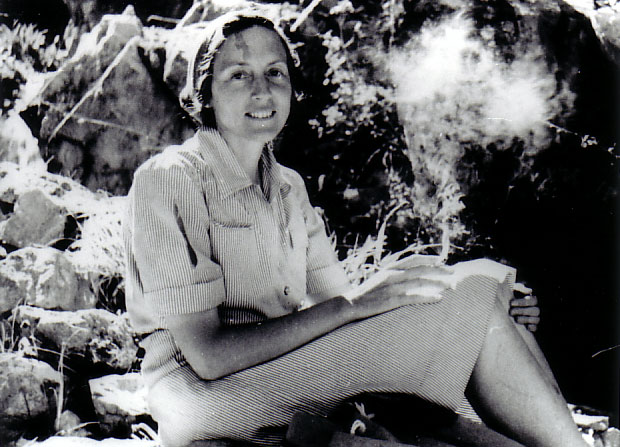
ASCSA picture of Virginia Grace in Turkey, WWII.


I heard a lot about Virginia Grace this year from women at the School, often during Loring Hall's long, extended 2-hour lunches, Mediterranean-style. Virginia was apparently a willowy, beautiful woman, meticulous and organized, who loved living abroad. In WW II she was one of many archaeologists to be part of the O.S.S., America's wartime intelligence service. She had an apartment in Kolonaki, where she hosted Sunday lunches for friends in the archaeological community. She also was a spark plug, prone to telling it like she saw it, with little patience for ridonkulous-ness. But she was nevertheless stalwart, and would even get you out of Greek jail if you happened to get arrested for trying to swim across channels patrolled by the Greek army...apparently. And she was loyal to the end - her fiancee died when she was still young, but she never remarried and, although she'd lived her whole life abroad, it was her final wish to be buried back in America at his side.

She died in 1994, at the age of 93, after being a member of the American School community for almost 70 years. Like many past members, her things are still part of the School's floating material culture. It's not just stuff like her billion ancient amphorae down in the Agora Museum, but other things, like that table on which she hosted so many Sunday dinners, now in another ASCSA apartment. And then there's Murder on the Orient Express, which I've finally read, thanks to some connection that Virginia Grace had with ancient Corinth's dighouse. Books seem to be an especially common way for past archaeologists to connect with the younger generation in these here parts. Whether it's the enormous book collection of Ida Hill and Elizabeth Blegen, or Doreen Spitzer's book of poems, or Virginia Grace's archaeological contemporary, Agatha Christie, I highly suggest picking up a book next time you hang at the School - you never know who you're gonna meet.

Wednesday, June 3, 2009

ROMULUS!

The fantasy novel has always liked things of epic quality, things dramatic, immense and vast. Tolkien’s Lord of the Rings is often discussed as if it were the first truly epic fantasy story. Page-wise, the three-novel tale was not a short one. Yet, it was also gigantor in scope, spanning not only numerous landscapes, but many cultures, characters, and languages. As another epic feature, Tolkien’s story emphasized culturally significant issues, such as the nature vs. technology dichotomy, or the general WW II-era unease displayed in Tolkien’s frequent contrasts between the local and the foreign. Most importantly, though, the trilogy involves the biggest, grandest and most human of subjects; it’s all about life, death, friendship, loyalty, good, evil and war. And, of course, the Fate of the Universe - the nature and survival of the universe itself is always a solid indicator of something that is totally EPIC.


In The Neverending Story, the very existence of the universe disintegrates before The Nothing. Only Atreyu can save it, but while doing so he loses Artax to the Swamps of Sadness. It was heart-wrenching, and I’m not sure that I really ever got over this part of the movie, even as an adult.


So fantasy loves the epic. After all, there’s even a subgenre called epic/high fantasy.


Sci-fi isn’t immune either, with Asimov’s Foundation series or Herbert’s Dune saga being about as epic as you can get, spanning thousands of years, characters and cultures, with the latter mixing in some serious existential questions here and there for fun.


Also a fan of the epic-ness is the entire genre of metal. There’s no question that metal has always included mythical elements - plus its big 80s heyday coincided with the rise of Dungeon and Dragons (read more on metal and D&D here).

My favorite band in 6th-grade. And yes, I still think they rule.


While there actually is a subgenre called ‘epic fantasy metal,’ metal’s love and dalliance with fantastical and momentous themes shows up even in the art and songs of mainstream bands; it also positively saturates the more subgenre-oriented groups.

Ever popular in Tallahassee, Florida, land of my Master's degree.


So it makes perfect sense that metal has finally merged with the ancient epic. In particular, it has embraced one of the most famous and enduring epic stories known to us, the tale of the founding of Rome. Livy, the Roman historian of the late 1st century BCE, tells of the twins Romulus and Remus, exposed as infants and nursed by a she-wolf. Many accounts of twins or siblings end up with an insurmountable rift growing between them, oftentimes because one is good and the other is bad. Romulus and Remus seem to be relatively normal (if you count wolf-suckling as normal), at least up until they come into conflict over the foundation of Rome. Brother kills brother and, when all’s said and done, Romulus is the lucky guy to get a city named after him.

I’m not sure why this hasn’t happened more often, but lucky for us, there’s now a band out there called Ex Deo that has created a concept album about Roman history. It’s a death metal group that’s a side project of another band, but apparently they’re getting pretty popular among death metal connoisseurs. And it looks like, now that their new song about the 13th Roman Legion is out, even Italy is a fan. The lead singer recently said:

“Word of mouth has been spreading like wildfire worldwide about EX DEO at the moment! I didn’t think there were so many metal heads that were into the concept of the band and Roman history as much as I am. I was anxious to see the response of the people of Italy and Rome today and the media there has accepted us with open arms. Now with their seal of approval we can show the world ROME! [We have] another defiant track called 'Legio XIII.' It’s a song in honor of ROME's most devastating and lethal Legion ever assembled; the 13th Legion which helped bring Caesar to power.”

And so Roman epic becomes popular again. Hollywood tried to do the ancient epic it with Homer and Brad Pitt, but failed. Perhaps instead we can pin our hopes on Ex Deo. Check out the totally amazing video for their title track, ‘Romulus.’ For those without a death-metal-trained ear, the lyrics go along these lines: “Romulus, from the wolf's mouth, I feed eternity/ Romulus, with my brother's blood I opened wide the gates of time/ Standing at the hill cliff, a flock of birds crown me/ I am fathered by the god of war, I am the king of Rome/ Then his jealousy blooms, the envy to lead my people/ So perish everyone who shall leap over my wall!"

I can’t wait for the 13th Legion video!