Showing posts with label archaeology. Show all posts

Saturday, July 5, 2014

2014 Season, Here We Come

The new season at Poggio Colla is underway and we are back on top of the hill exploring the ancient Etruscan past. As usual, brambles overtook the site, but this time, we made the students help us remove them. Ha! Suckers.


We are finally finished unbackfilling two trenches, after days of picking, shoveling, and wheelbarrowing. PC 45 has been unveiled!


We broke ground in my old trench after leaving it abandoned last season. Interesting new info about the site's construction history has already been revealed and, for once, it makes sense. I am in stratigraphy heaven!

Tuesday, June 25, 2013

Heirloom Archaeology: The Yard Edition Pt. 2, St. Francis

When I grew up, I assumed everyone had a St. Francis in their yard. We had one. Others in my family had one. When I asked who he was and why he was there, I was told that he protected and encouraged happy wildlife, that he would bring bounty to our little garden. He brought good luck to the yard and the squirrels and the morning doves.

Garden statues of holy figures are a tradition especially loved by Catholics. The concept and general idea behind them will be familiar to those studying ancient shrines for nymphs and other locally sacred beings.


In our family, St. Francis is the dominant garden statue and his presence can be traced to one particular image. It's the most 'sacred' in the family because its the oldest and it reaches back to the elder generation's childhood. It's been through hurricanes and moves, has been broken and reassembled, but somehow its still standing. It's the talismanic Athena Polias of the clan.

The statue of St. Francis has lived in the garden of the ancestral home's courtyard. The courtyard itself has gone through numerous changes over the years. Back in the day ('50s) there was even a palm tree in the middle.


This is where the grown ups sipped their cocktails: Myrtle Rask (my grandmother) and Anna Mae Sirl (great-grandmother).

But St. Francis was there, his toes in a bird bath, surveying his domain. He spent the years encouraging all the tropical plants to go wild, watching over the tiny lizards zipping across the patio, and providing a perch for song birds come to raid the bird feeder.


Analysis of the photographic evidence shows that nowadays St. Francis is in almost the exact same location, with some of the exact same plants still thriving under his protection.

St. Francis in 1958.


Best of all, he's still protecting the little animals :)


Tuesday, July 13, 2010

Trench Talk

Just a quick update from Poggio Colla and sweltering, blistering Tuscany. It's hot! Things are going along well in the trench. In fact, today was by far our most exciting day yet. Trench 42 now has several different walls and all sorts of spaces in need of excavation. If you want to read more about it, check out the little blog I had to write for the project's website.

So you want to know what happens in my day? We head up every day before the students at 6am so the supervisors get a little time to get some serious work done.

The trench supervisors of PC 43, taking advantage of the dirt pile.

Then the students arrive and we attack the dirt with all we've got, stand around looking perplexed, or play trench games (like 'Guess what so-and-so was like in highschool'). Either that or we're stuffing our faces at Cookie Break.

Members of PC 42 (my trench!) revealing a Hellenistic-era wall. Thank the Lords of Cobal for the Italian forestry service, which declared that the chestnut trees on the hill are protected, and thus ensuring that we're protected, too - from the sun and the hell-sent kamikaze flies that come with it.

The students have had all sorts of workshops, learning about everything from roofing systems to pottery to settlement patterns.

Angela Trentacoste, the Bone Lady, teaches the students about zooarchaeology.

Stratigraphically, things have really picked up in the last few days. In fact, there's been an actual flurry of archaeological activity. Picks flying, trowels slicing, sieves swishing. Tomorrow I promise I'll have exciting things to report, before it's off to Elba or some other beachy place for our four day weekend.

This is what an archaeological flurry looks like. Myself and trench assistant supervisor Mike Guarino.

Saturday, July 3, 2010

A quick photo intro to Poggio Colla

Greetings from Italy. It may seem shocking, but after almost ten years of work in Greece, I am excavating in Tuscany this summer. The reason is simple. While most of my experience is in Greece and my dissertation is on Greek material, my secret love is Etruria and Etruscan religion. Therefore, I am happy to say that this summer I am working at the Etruscan hilltop site of Poggio Colla.

Greg Warden, the excavation director, lectures to the Poggio Colla field staff at the Dicomano museum last week. Those are Etruscan grave cippi (markers) in the background.
The Poggio Colla excavation is a field school that has been running for about 16 years now. The designation ‘field school’ means that undergrads come here to learn archaeological methods. They attend lectures, they have homework assignments and during the day they excavate. There are about 20 students, four trenches and a wide variety of staff.

My trench is the Trench at the End of the Universe – that is, it's Trench #42. (If you didn’t get that Hitchhiker’s Guide to the Galaxy reference, then shame on you.)

Me and PC-42.

Normal archaeological goings-on. That guy on top is my trenchmate and fellow staff member, Mike.

The students move the tile pile (a gigantic mound of trashy tile fragments accumulated over 16 years of excavation) that partially overlaid the corner of my trench.

The students practice their troweling skills.

We live in various buildings interspersed throughout a huge former estate in the Mugello valley, just north of Florence.


My pad.

We eat dinner here, overlooking the Mugello valley.


My first trip to Italy was not notable for its food. At all. This time, however, the food situation is quite different. A lovely Italian lady named Beppina cooks for us each night and is wonderfully sensitive to the needs of newly-converted vegetarians (=me). Of course, on the weekends we must forage for ourselves:

Ariel of the Metropolitan Museum of Art enters the regionally famous Casa del Prosciutto.
The staff eats a gigantic three course lunch at the Casa del Prosciutto on Saturday (today).

Fortunately, the student house recently got the internet up and running, so I will be posting weekly. Stay tuned.

Wednesday, June 10, 2009

Dear Virginia, Merry Christmas

Up until this season at the Corinth excavations, I had never read any Agatha Christie. I've never been much of a crime/mystery novel reader - that's my aunt and grandmother, whereas I lean towards speculative fiction. I guess Agatha Christie doesn't really need much introduction, since she is the world's top-selling author EVER. Her books come second only to the Bible in popularity, with over 4 billion sold. And now I can join the 4 billion readers of Agatha Christie.

What's interesting about Christie, though, is that she was familiar with the life archaeological. The mystery author was lucky enough to work at the excavation of Ur and Nineveh, and her book Murder in Mesopotamia is set in an archaeological dighouse. In the 30s she married Max Mallowan, a British archaeologist who was even director of the BSA in Iraq. Christie wrote all about being part of an archaeological family in her book, Come, Tell Me How You Live - she had worked with her husband in the field, keeping notebooks and mending excavated pottery.


Christie with Leonard Woolley and her husband Max Mallowan at Ur.

Like Loring Hall in Athens, Corinth has a few book shelves filled with novels left behind by visitors and more permanent residents. A few of those novels are by Christie, and I decided to go for the Orient Express because it was the most recognizable to me. When I opened up Christie's book, I saw this:
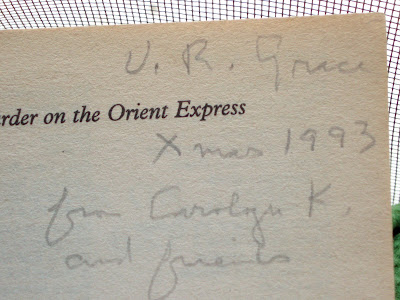


It's not uncommon to find names scrawled on the inside covers of ASCSA novels. Some of them, in fact, can go pretty far back, like this one from Doreen Spitzer:


Spitzer was a long time member of the ASCSA community and Trustee of the School. Cosy (her nickname) signed this book in 1966 and left inside a draft of a little rhyming poem, written as an introduction for the president of Bryn Mawr College.

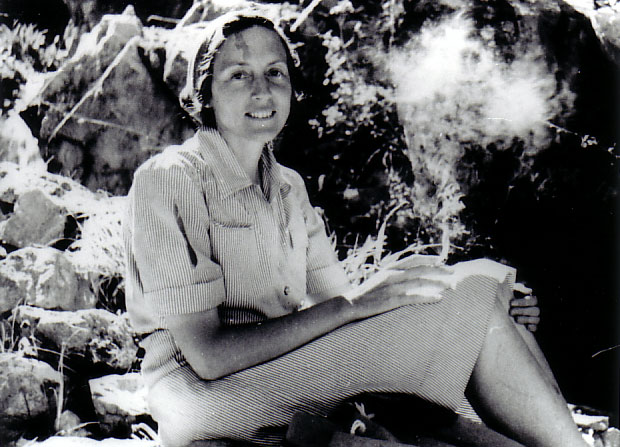
Virginia Grace, who signed her Agatha Christie book one year before she died, is something of an archaeological celebrity (read her biography here). She first came to the American School in 1927, the same year as Lucy Shoe Merritt, with whom she became travel buddies. She ended up spending most of her life in Athens, and most of that would be dedicated to studying the stamps on amphora handles.


She collected drawings of the little stamps and catalogued over 25,000 of them...This may sound incredibly boring...In fact, apparently everyone else thought it WAS boring, since no one else came up with the idea to study them in such detail. Basically, Virginia Grace single-handedly started the specialized sub-field of amphora stamp analysis and typology.

But why the hell would anyone want to study them?

The amphora stamps tell where and when an amphora was made. Amphorae themselves are like the ancient version of wooden barrels, filled with wine, salt fish, olive oil, or some other trade good. They were stacked in the holds of ancient ships and sent all over the Mediterranean. They have become especially important for underwater archaeology; more often than not, although wooden ships don't always survive, their resting place on the seabed can be identified by clusters of amphorae. And thanks to Virginia Grace, archaeologists can date these shipwrecks by the amphora stamps .


Even at my very first excavation in 2001 I heard about a little old lady who had lived in Athens and collected notecards with amphorae stamps. At the end of excavation seasons archaeologists would bring Virginia drawings of newly excavated stamped-handles, so that she might add them to her notecard collection. For decades Virginia Grace was at the center of a social and professional network stretching out in all directions, extended by each archaeologist who looked at an ancient amphora thousands of miles away and immediately thought of her. She was an eternal hub at the center of a remarkable net, anchored down in the storeroom of the Agora excavations at Athens. (And yes, I know, she even inspired me to mix my metaphors.)

ASCSA picture of Virginia Grace in Turkey, WWII.


I heard a lot about Virginia Grace this year from women at the School, often during Loring Hall's long, extended 2-hour lunches, Mediterranean-style. Virginia was apparently a willowy, beautiful woman, meticulous and organized, who loved living abroad. In WW II she was one of many archaeologists to be part of the O.S.S., America's wartime intelligence service. She had an apartment in Kolonaki, where she hosted Sunday lunches for friends in the archaeological community. She also was a spark plug, prone to telling it like she saw it, with little patience for ridonkulous-ness. But she was nevertheless stalwart, and would even get you out of Greek jail if you happened to get arrested for trying to swim across channels patrolled by the Greek army...apparently. And she was loyal to the end - her fiancee died when she was still young, but she never remarried and, although she'd lived her whole life abroad, it was her final wish to be buried back in America at his side.

She died in 1994, at the age of 93, after being a member of the American School community for almost 70 years. Like many past members, her things are still part of the School's floating material culture. It's not just stuff like her billion ancient amphorae down in the Agora Museum, but other things, like that table on which she hosted so many Sunday dinners, now in another ASCSA apartment. And then there's Murder on the Orient Express, which I've finally read, thanks to some connection that Virginia Grace had with ancient Corinth's dighouse. Books seem to be an especially common way for past archaeologists to connect with the younger generation in these here parts. Whether it's the enormous book collection of Ida Hill and Elizabeth Blegen, or Doreen Spitzer's book of poems, or Virginia Grace's archaeological contemporary, Agatha Christie, I highly suggest picking up a book next time you hang at the School - you never know who you're gonna meet.

Wednesday, May 6, 2009

Syrup, of one form or another

I've been in Corinth the last week and a half so I have a been a bit slow on the blog front. I have some ideas banging around in my head, but need time to actually write them out. Plus, I am STILL transcribing an interview with a member of the 1959-60 Regular Year.

I'm here participating in the Corinth excavations, where we are working on a Frankish/Byzantine area of the site. The days are long, which leaves little time for thinking hard about anything other than deposits, fills, cuts, wells, robbing trenches, foundations, etc. And I'm not joking - I'm having freaky archaeological dreams every night.

There's a lot to learn about the history of Corinth and the excavations, much of it institutional, but more of it as 'oral history.' I'm working on it, but for now, here's a little story.

Corinth doesn't have tea hour (we have mid-morning snack, instead). Like at Loring, it does have ouzo hour at 7pm:


Ouzo is served, believe it or not, in a Mrs. Butterworth glass bottle.


This is actually a long-standing, 40 year old tradition. Some 15-20 years ago the Butterworth Ouzo Bottle got dropped and shattered - major party foul! A new one was purchased; the one we have now is about two decades old.


Woe to the person who drops this Mrs. Butterworth bottle- they've gone out of print.

Monday, March 23, 2009

ASCSA Turkey Trip: Cute Overload Meets Archaeology!

Part of travelling is learning to appreciate the local fauna. Sometimes this includes rapacious merchants or the skeezy kamachi (‘spear fisher,’ dudes who sit around trying to pick up women). Usually, however, it’s the non-human variety of fauna that we encounter. Unfortunately, many countries suffer from a lack of televised series’ like Animal Cops.


If they did, they might learn that (the US considers) the neglect of an injured or sick animal to be the equivalent of animal abuse. On the one hand, countries like Turkey and Greece don’t always have a culturally embedded belief that cruelty to animals is a moral failing (although cruelty to chickens and cows is perfectly okay – the U.S. government says so!). On the other hand, many countries do not have the infrastructure, educational programs or governmental support to help animals in need. So travelling involves being faced with a great deal of needy and inhumane-ly treated animals. I’ve gotten used to looking the other way a lot, just to avoid seeing chill-inducing and pathetic creatures. Alas, if only we all had a Sgt. Lucas.


But my blog is 80% sugar-coating, so I thought I’d emulate one of my own favorite blogs, CuteOverload, by documenting all the cute animals we’ve seen gamboling around archaeological sites. Cute animals and antiquities - can it get any better?!

This little darling met us at the tetrapylon (monumental gateway) in front of the temple of Aphrodite at Aphrodisias. He was so adorable that we took him with us throught the whole site so we could make sure he got safely to civilization.
Here he’s hanging out with a Roman mosaic and following me down some steps in the civic center.
He also got a bit rowdy after his manliness was insulted by a much bigger and tougher kitty. I imagine he’ll make a good site guard dog one day.

Definitely prosh; the ancient tiled floor really adds to the ambience.

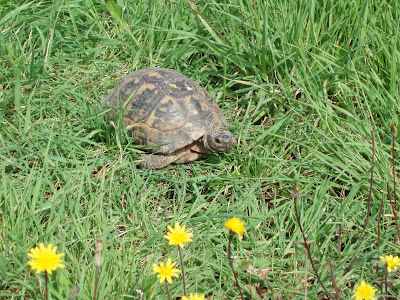
Turtles! OMG they totally rule.


These crusty dudes were munching on some leafy goodness about 10 feet away from the krepidima (base) of the temple of Apollo at Didyma.


This little guy is hanging with his mother at the top of an ancient Greek theatre (Iasos). Note that he’s scratching his head on the signage, which lays out all the details of the theatre.


This scruffy tramp of a Benji is standing directly next to the tomb of St. John in the eponymously named church in Seljuk (just next door to the Sanctuary of Artemis at ancient Ephesos, one of the seven wonders of the ancient world). The columns and white pavement behind him mark the tomb of the saint, although which John it is, is a matter of long-standing debate (whether John the Disciple, writer of Revelations, John the Theologian, or all of them in one). Incidentally, three people were buried in the tomb along with coins of Geta and Caracalla (2nd c. CE).


We really don’t see a lot of cows in Greece (mostly goats), so everyone gets pretty excited to see a good ‘ole milk cow now and then. Since we’re always traipsing across pasturage in search of ruins, we see a lot of herd animals these days. Yesterday Eric was happy to see a herd of cows at the site of ancient Magnesia-on-Meander.

On our way to see the Bouleuterion, situated in the backyard of the 'Bouleuterion Lady' (at Herakleia-under-Latmos), we ran into some traffic on the road.


Yes, those are tadpoles. And the white marble blocks around which they’re darting come from the drowned stoa at ancient Miletus.

Turkey sits along the migration path of this part of the world’s stork population, and it is common to see their huge nests atop high platforms.

Here some love-storks hang out in their nest on top of the one standing Corinthian column from the Temple of Zeus in Mylasa. Either that’s a wing, or that stork has a diaper in its beak.
This was a shock. Don Bey was leading us through the Museum of Underwater Archaeology when we saw this guy on the museum display. I felt like I was in Malfoy Manor, since they even had an albino peacock (although I didn’t get a picture, alas).


Fancy!

Thursday, February 19, 2009

Ta-da! The Theatre of Dionysos


If you like ancient tragedy, this is where it happened. You know, Euripides, Sophocles, those sorts of dudes. I'm sure you remember: the gouging of eyes, mothers ripping off the heads of their sons, corpses left to rot, crazed and wandering souls, bath tubs full of blood, soups made from children...all the good stuff, the original horror movies. 

Well, it happened right here, folks, at that one line of rocks. So they think. Those four blocks may very well be all that's left of the original version of Athens' Theatre of Dionysos.

Alright then. Carry on.

Tuesday, January 20, 2009

Good ol' Mnesikles: Climbing on the Propylaia

We did the Propylaia today. That's the monumental gateway on the Athenian acropolis, constructed in the 5th century BCE. We were given a tour by the architect in charge of the Propylaia's reconstruction, Mr. Tanoulas.


It was a chance to climb all over the building, check out its various rooms, and see what it looks like from behind.
The northeast room of the Propylaia, looking towards the Parthenon.

I think we were most looking foward to climbing on top of the Propylaia, since last year's Regular Members were going on about how awesome it was. (Of course, they didn't get to climb up the Frankish tower in the Parthenon - Booyah!) At the end of our tour, we were given the chance to visit the Propylaia's roof.
Climbing up the scaffolding.


We got lucky. It was another absolutely gorgeous day.

Regular Member Tom Garvey looks down into the northwest rooms of the Propylaia.


Eric was walking around with a goofy grin on his face the whole time; it was hard not to enjoy the view, the sunlight and the novelty of being on-top of the famous ancient structure. Meanwhile, we got to see all the architectural tidbits up-close and personal, in a way that usually only happens in an art history classroom, when pictures are blown up to gargantuan sizes.

Hanging out with architectural elements. Hello, triglyph.
Cool day.