Way back in the day when I was a more dedicated blogger, I did some posts about the graves of archaeologists (here and here and here [not an archaeologist, but whatever]). I always meant to follow up with some additional posts but, as happens, I never got around to it. I still think it's an interesting project, though, so I thought it would be worth returning to.
Here we go:


And just as a quick note, there are many more graves of archaeologists and classicists in the First Cemetery that need to be documented. For example, if you feel like stopping by, visit these people (courtesy of Dan Leon):
Here we go:

John Pendlebury's story has reached truly historic and heroic proportions. He was a British archaeologist associated with the British School next door to the American School. He worked at two of the most famous Mediterranean excavations EVAH, Tell el-Amarna in Egypt and Knossos on Crete. During WWII, he stayed on Crete as a British spy and in so doing won the hearts of Crete's entire population. The story goes that nobody on Crete knew who the hell Sir Arthur Evans was, but they all knew Pendlebury. He was wounded and captured during the German assault on Crete. The Germans stood him up against a cottage wall and shot him through the head. He's buried at the Commonwealth cemetery at Souda Bay.


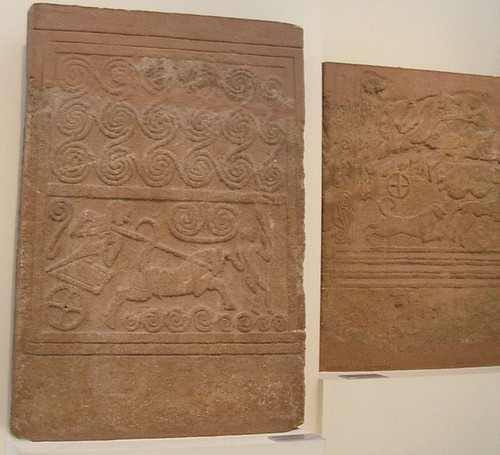
Like Pendlebury, George Mylonas had his own war story. A soldier during the Greco-Turkish War (1919-1922), he was captured as a POW. His Smyrna-based family lost virtually everything in the war, but he went on to become a prominent archaeologist in Greece. He was a student of David Robinson at Olynthus and in the late '20s he even served as the Bursar of the American School in Athens. He's most famous for directing the excavations at Mycenae - he's the guy who led the excavation of Grave Circle B. He's buried down the hill from Mycenae in the same little cemetery as Humpfrey Payne. Like the Blegen's grave in the First Cemetery in Athens, Mylonas' sarcophagus is decked out in a way that links him to the ancient peoples he studied - the spiral-y things running along the bottom are a decorative motif visible in Mycenean art. (I'd like to thank Vassiliki Pliatsika for providing me with the pictures of Mylonas' grave. Thanks!)
And just as a quick note, there are many more graves of archaeologists and classicists in the First Cemetery that need to be documented. For example, if you feel like stopping by, visit these people (courtesy of Dan Leon):
Arnold Hugh Martin Jones (1904-1970) - Author of "The Later Roman Empire, 284-602" and apparently popular with all the Late Antiquity peeps, even if he wasn't big on archaeology. He had a heart-attack on a boat on his way to deliver a series of lectures in Thessaloniki.
Adolf Furtwaengler [whom I've already noted - but it doesn't hurt to give him further props] (1853-1907) - Wrote a dissertation on vase painting, was instrumental in the development of the 'comparative method,' participated in the excavations at Olympia, and co-authored the first corpus of pottery finds ever (Mykenische Thongefaesse, from Aegina). He helped to come up with the idea of using pottery and stratigraphy to create a chronology. He wrote a bunch of stuff on vase painting and sculpture, ran a few museums and digs, published a monograph on Aegina, but contracted dysentery there and died.
Gregory Vlastos (1907-1991) - Possibly the Gregory Vlastos who published widely on pre-Socratic, Socratic, and Platonic philosophy and is credited by some with bringing about a renewed interest in Plato in the philosophical community.