Showing posts with label visual culture. Show all posts

Saturday, October 23, 2010

Why my niece and nephew are getting this

The Book of Kells is considered Ireland's most precious treasure.


Looking at it really does make the eyeballs bleed, in the best way possible. When they talk about works of art making people cry, instead of thinking of about Michaelangelo, I think of the nameless scribes who made the Book of Kells.


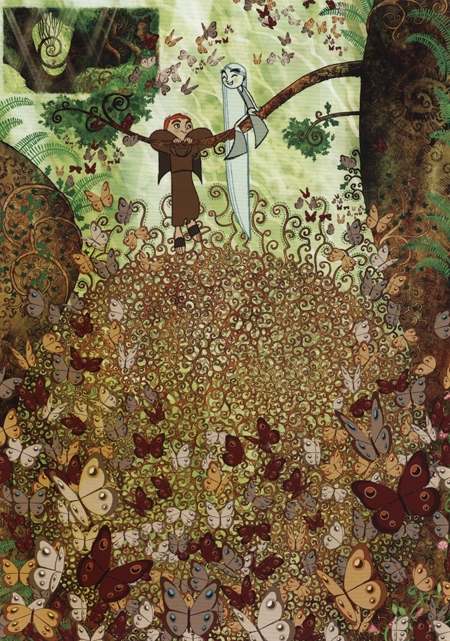
Last year an animated movie was released called The Secret of Kells. It relates a fictional story about the making of the book, full of little details aimed to please Medievalists and book lovers every where. For example, in the 8th century an Irish scribe wrote a poem about himself and his little cat Pangur Bán. The little cat in the movie is named, of course, Pangur Bán.

Anyhoo, the animation is jaw-dropping. Absolutely gorgeous. Most interesting of all, the animation is inspired by the art in the Book of Kells. It is at times ornate, rich, with jewel-like detail.


My favorite bits, though, are the bits that use Medieval approaches to depth; the landscapes are flattened, linear, objects and buildings are shown from multiple perspectives at the same time (e.g., from the side and from above).


Like Medieval art, the movie avoids 'true' single-point perspective. Seeing it was a great reminder of the many ways that images can tell stories; the Western ideas of perspective and naturalism are not our only option!

Plus, the movie was a love story written for a book, a book that loved images as much as it loved words. And that's why my niece and nephew are getting it. The movie, that is.

Tuesday, September 15, 2009

Ithaca, New York: The Social Dynamics of the Poster Sale

One thing that has surprised me about the poster job, more than anything else, is the social codes embedded in poster buying. It never even really occurred to me, but now that I work poster sales, I am blown away by how seriously crucial it is to the college experience and how much you can learn about social norms through the whole poster process.

First, of course, is the sheer number of people who come to the poster sale, and who actually wait all year for it. They show up and say things like "Last year you had such-and-such a poster and it was on sale for such-and-such a price? Have you still got it?" Hell, I vividly remember going to the poster sale when I was a freshman in 1997, and plastering my room with Casablanca posters thereafter. The poster sale is actually an Event, an Event that's important because posters are vital in helping college kids create an identity.

That may sound like hyperbole, but it's really not! For a lot of these kids, it's their very first chance to decorate their space without parental input, and they choose subjects and images that convey important information about themselves. Sure, creating a certain mood and having a connection to the 'feeling' that posters create is a huge part of it. But so is making sure other people know what you're about and what you like. It's all bands, movies, quotes, and famous people. And in the end, there is a surprising amount of division along gender lines.

Girls buy this.


Dudes buy this
.

Now, it's no big secret that college males want to buy pictures of naked chicks for their walls, as one of this year's classy top sellers for frat boys attests:


The whole visual objectification of women is well-acknowledged. At the least most guys know that they should feel slightly ashamed about buying this sort of thing, thankfully. The above poster, when purchased, is usually tightly rolled up when brought to the register, or covered by a second, less offensive image. Naturally, I make sure to pull out the Nice Rack poster in a very visible manner, with a flourish, so that everyone in the near vicinity can catch a glimpse of what dude here is buying. But. I have to say, I have been much more horrified by what the women buy!

When it's not the black-and-white images of Kim Anderson's cutsey children dressed up like grown-ups, it's more often than not a picture of two people kissing in a romantic embrace. This I do not understand. Why do you want a picture of two strangers (not from your favorite movie or video or band) making out - on your wall?!

Here's some examples of the top sellers this year:


Any reference to Paris ups the sales instantly.

There two are entitled 'Urban Romance':


And who could forget:


Seriously. All of these. Top-sellers. And there's actually a LOT more that I didn't include here. In the end, 'the kiss' is objectified by women just as much as the female body is objectified by men. People always comment that men generally fixate on bodies while women instead fixate on the notion of romance. Sure. But nothing has made me more sure that this is culturally conditioned than working on the poster job. Why the hell are these images so popular? It's not just because part of buying a poster is the creation of a mood and a haven and a home. It's because the largest part of buying a poster is acquiring social and cultural identifiers that can be plastered on your wall for everyone to see. It communicates a message to other people who can recognize that message.

I don't know. My present poster partner Matt has said that if he ever went home with a girl who had one of these romance images on the wall, he would run the other direction. As fast as possible. So I guess in these cases women buy smoochy pics for other women. In fact, they sure do seem to buy them while in groups.

Friday, February 20, 2009

ASCSA Art 1: Dinner Table Art in Loring by Piet de Jong

It is a generally held belief that art is used by people and groups to define themselves. After all, what you’ve got hanging on your walls says a lot about you. From the wall-paintings of the Romans to the posters plastered on freshman dorm-room walls, art is often meant to convey something about its owner, to ooze class, taste, hippness or to be cutting edge. So what, I wondered, does the art of the American School say?

Today begins my new feature on the Art of the American School. I’ll try to post on this topic as regularly as I can, but I won’t pretend that I won’t get side-tracked by other things as well. Especially as we get to the end of the semester and I have four more reports to research (Jane Harrison! Plato’s Academy! Underwater archaeology! Aphrodisias!), I’m running out of time, with a quickness.

Mostly I’ll be addressing the paintings/prints hung on the walls of the Blegen Library and Loring Hall. As I’ve wandered about I have mentally categorized this art into four groups:

1) Portraits – mostly of American School celebrities
2) Landscapes of Greece – showing either idyllic scenes with traditional Greek stuff or
depicting ruins
3) Replicas of ancient works – enlarged versions of ancient artifacts, such as pottery, mosaics, etc.
4) Items of Erudition – stuff that you put on your office wall to show your smartness, like Ye Olde Maps, Renaissance-looking philosophers, engravings of personifications, etc.

I wanted to start with a room that I sit in everyday, Loring Hall’s dining room.

A series of watercolors hang on all four walls, by Piet de Jong.
Piet de Jong, Porch of the Parthenon

By whom, you ask? Piet de Jong, the most influential artist working for the American School (and British School) in the 20th century. Hmmm, that still may not be overly helpful. If any of you have been to Knossos on Crete, then you are well-versed in his work, as he reconstructed the wall-paintings there. And of course, if you have ever studied Mycenaean Greece, then you will have seen his most famous reconstruction of all:
Reconstruction of the megaron at Pylos.

He actually did a whole array of work, from caricatures to site plans, to pottery sketches, to beautiful illustrations of ancient artifacts (see Papadopoulos 2007; Hood 1998, Faces of archaeology in Greece). I’ve been staring at his landscapes while I eat dinner for a while now, but to me, they were rather vague pictures of trees and rocks from the 1920s and that was all. But yesterday we went to the South Slope of the Acropolis, and when I came back and looked at his paintings again, I was in for shock.

You see, while we were walking towards the Odeion of Herodes Atticus, I stopped and looked up at this really amazing image of the Parthenon, one corner of the building just barely peeking out at us. I remarked on it to Margie, and she was impressed by the very blueness of the sky. Thirty minutes later, just about to eat lunch, I realized that Piet de Jong had stood in that very exact spot in the late 1920s and had also recognized what a fantastic picture it might be:
The very tippy edge of the parthenon above the Stoa of Eumenes. Piet de Jong.

I’d looked at that picture, close up, on several occasions, and never realized what it was until I came back from standing in the same place as the artist.

Then there was the matter of the Theatre of Dionysos. Just above the theatre a guy named Thrasyllos built a gigantic monument in the bedrock of the Acropolis. He cut into a cave already present on the slope, added some statues, and threw in some enormous columns. The monument is currently being restored, but it played a big part in our morning escapade. And lo! Piet de Jong painted it not once, but twice, from two different directions.

His watercolors, I admit, are not my favorites; I like a lot of his other work far better and may address some of it here in the future. But it’s nice to know that the paintings on the wall, hung from fishing line, are those of an archaeologist at the School. It’s even better to see the angles and views of the sites we’re seeing every day, there in watercolors. It’s also slightly creepy, for some reason that I haven’t quite figured out. At least I’ll now always have some strange obsessive fascination with that one view of the Parthenon, sticking its head up over the Stoa's broken arches.

Wednesday, February 4, 2009

My Morning Walk: Street Art and Graffiti in Athens

On Tuesdays and Thursdays, we have excursions within the city of Athens, in contrast to our Friday trips to various parts of Attica.


Regular Members climb the hillside at ancient Koroni on last week's Friday Trip.

Most of our Tuesday/Thursday events start out in the ancient center of the city, either on the Acropolis, at the Agora, or at the Kerameikos. We tend to meet at these locations at 9am, and there are two options for getting there: 1) walk 2) take the Metro. I have been avoiding the Metro, in an effort to maintain at least a minimal amount of exercise.


When I go to the Acropolis, I tend to wander around the south side through the Plaka. I do this in order to avoid the horrible hill on the north side, which must be climbed on your way past the Agora. Now, granted, there is a big hill to climb on the south side as well, but I don’t think it is quite as big. Maybe it is – I’m thinking it’s purely psychological, but I don’t care.

Approaching the south slope of the Acropolis, in the vicinity of the Theatre of Dionysos, where all those famous Greek playwrights put on their ancient tragedies and comedies.

Getting to the Agora requires following the north side of the Acropolis, along Ermou St.


Regular Members, this past Tuesday. Any group of more than three people attracts escorts of dogs.

And then there is the street art, always interesting for how it shapes urban space.


‘Love me madly’ by Alexandros Vasmoulakis, October 2005. For a long time, I thought this was a three-story high picture of a man looking up a girl’s skirt.

But then I checked online and realized that originally it was a guy giving a flower to his sweetheart. Funny how the elements have completely changed the artist's original vision, into something that can be interpreted as creepy rather than romantic. Check out the artist’s work here; his site is zap51.com.

The Athenian Agora. Visible in the foreground are the blocks of the Royal Stoa, where the King Archon of Athens went about his business, indicting Socrates and other such fun things.

Behind the stoa, you can see the work of Pete, one of the most prolific street artists in the city. Dimitris Plantzos calls him "Athens’ dark prince." His work is here modeled by John Camp, Director of the Athenian Agora Excavations.

Since I received so much positive feed back on my original Athens graffiti art post, I thought I would post some links for those interested in following up on it. My post can be considered part of a growing upsurge in grafitti art interest among Classicists working in Athens. In fact, there is a dialogue going on in the Classics Blogosphere about what Kostis Kourelis has called 'Punk Archaeology.' The back and forth between Bill Caraher and Kourelis has turned into a blog called, you guessed it, Punk Archaeology.

The Flickr collection of Athens street art, here.
Artastica's blog 'Street Culture - Athens.'
Flickr page of Pete's work, here.
Gregos and Goldstein's book, Athens Street Art.
SpirosK's Flickr collection, 'Street Art in Greece.'
Zofka's photoblog about Athens, 'Street art.'

Monday, October 27, 2008

Religious Visual Art in Konstantini: Iconography and Blasphemy

I study dead religions. They’re fun. But I still see and think about living religion all the time. On the trips, we’ve randomly seen a great deal of interesting things relating to religion in practice, and so I thought I’d make a few posts over the next few months on the more noteworthy or quirky or freaky things we’ve come across. I’ll start with one of my favorite works of religious art here in Greece so far.

During Trip II, we visited a small church in the town of Konstantini because it had a very important Lex Sacra built into the wall of the entrance. Dan Leon gave his site report on the ancient decree (from Andania), which has some very valuable information about ancient Messenian religion and mystery cults. Besides the ancient stuff, one of my favorite things was this picture, framed and hung on the door of the small church. The text accompanying the image says basically: “Don’t Blasphemy.” It details all the horrible things that will befall those who do so.

What I especially love about it is the iconography. What does it tell us about blasphemy and those who practice it? Here’s my art historical approach to the pic. First, let’s see what it actually shows. Jesus hangs upon the cross. At the base kneels a soldier, hands clasped in prayer and head bowed, eyes closed. His gun has been laid at his side and his helmet rests before him – he seems to have come straight from the Front. He has short-cropped hair and is clean shaven. As a soldier he is a brave young man defending his people from evil; he is pious and correct, humble and thankful. But behind him is his mirror opposite.

Another young man, decked out in the latest fashion, moves towards the peaceful scene. He has long hair and enormous side burns. His pants flair at the bottom. His demeanor is loud, he struts about, his head is raised defiantly towards Jesus, rather than lowered as it presumably should be. He looks like a spoiled city brat, a late night drinker, the kind of man who hangs with less-than-demure women. He clearly lacks any discipline whatsoever and wastes his time doing frivolous things while the humble soldier does his duty. The contrast between the two could not be more pronounced. The townie’s words, blasphemy physically aimed towards the cross, spews out and up - but it hits an invisible barrier just at the location of the young soldier, leaving him and his god in a protective bubble. The blasphemous words bounce back towards the upstart, changed into rocks (my favorite part): he is condemned and stoned by his own words. The serpent creeping up behind him is either egging him on or it is waiting to consume him when he turns away from the salvation depicted before him.

It’s fantastic. As a composition it is split down the middle, the townie upstart and the serpent on one side, the pious soldier and Jesus on the other. It says a lot about rich kids that don’t serve their country when they should, and the assumed devoutness of soldiers. It contrasts rebellious fashionistas with those who wear modest and drab uniforms. It contrasts silent prayer with loud voices. It contrasts gi-normous monster snakes with the culturally weighty symbol of Jesus on the cross. Its message could not be more clear.

I wish I knew when it was made. The picture elevates blasphemy to a mortal sin, while reflecting that old dichotomy between the two stereotypical kinds of young men. What a totally brilliant picture. Love it!