Showing posts with label gender. Show all posts

Thursday, November 19, 2009

What prospectus?

I've been a little lax with the posting lately, I know, but I've been terribly distracted these days by my prospectus. For those non-academics out there, the prospectus is basically your dissertation proposal. It explains what topic you are going to research, why no one else has done it your way before, and how you're going to go about things. In my department, the prospectus is a 20-30-page paper that is presented to the department at a public 'defense.' Although my colloquium (i.e. public defense) is not until December 10th, I'm supposed to turn in the paper itself at the end of this week.

It hasn't been going very well. I've been struggling a lot with the paper and ultimately with what I want or need (future career-wise) my dissertation to be. I'm still not exactly sure that I know what I'm doing, or that I'm at all happy with what I have produced at this point.

So what did I do last night to clear my head?


Yes, that's right. I went to see Megadeth!
The show began on an interesting note with one of the opening bands. They'd set up these frames with fabric stretched over them to cover stuff behind them on the stage - identical frames were posted at either side of the band. At first I couldn't figure out what the image was:


And then it became clear that it was an image of a dead, mutilated woman, in a flowing robe, arranged poetically on the ground.


I love when people say there is no such thing as the 'male gaze.' It's bad enough in hip-hop, but I'd forgotten the physical violence associated with the 'male gaze' so frequent in metal. I officially loathe the band Suicide Silence.

But anyways, the person who I don't loathe, is this guy:


Dave Mustaine! Snarling champion of my ninth grade year!


I used to watch the video for 'Sweating Bullets' over and over and over in 9th grade: that was back in the day when you'd have a blank VCR tape in the machine so you could super-fast hit 'record' whenever one of your favorite songs came on MTV. It was unreal to see Megadeth standing in front of me, in real life.

Dave Mustaine is a god. Look, he even has a Guitar of Light:


Today I'm still partially deaf, my throat is hoarse from screaming, and my body aches like I'm decrepit. In other words, it was aaaww-suum! *singsong voice*


I went with Dallas and Brian. Afterwards we had midnight bacon-cheddar-cheeseburgers. Now it's noon and I'm wondering how I'm supposed to start coherently writing. I think I might just watch 'Sweating Bullets' a few more times instead.

Tuesday, September 15, 2009

Ithaca, New York: The Social Dynamics of the Poster Sale

One thing that has surprised me about the poster job, more than anything else, is the social codes embedded in poster buying. It never even really occurred to me, but now that I work poster sales, I am blown away by how seriously crucial it is to the college experience and how much you can learn about social norms through the whole poster process.

First, of course, is the sheer number of people who come to the poster sale, and who actually wait all year for it. They show up and say things like "Last year you had such-and-such a poster and it was on sale for such-and-such a price? Have you still got it?" Hell, I vividly remember going to the poster sale when I was a freshman in 1997, and plastering my room with Casablanca posters thereafter. The poster sale is actually an Event, an Event that's important because posters are vital in helping college kids create an identity.

That may sound like hyperbole, but it's really not! For a lot of these kids, it's their very first chance to decorate their space without parental input, and they choose subjects and images that convey important information about themselves. Sure, creating a certain mood and having a connection to the 'feeling' that posters create is a huge part of it. But so is making sure other people know what you're about and what you like. It's all bands, movies, quotes, and famous people. And in the end, there is a surprising amount of division along gender lines.

Girls buy this.


Dudes buy this
.

Now, it's no big secret that college males want to buy pictures of naked chicks for their walls, as one of this year's classy top sellers for frat boys attests:


The whole visual objectification of women is well-acknowledged. At the least most guys know that they should feel slightly ashamed about buying this sort of thing, thankfully. The above poster, when purchased, is usually tightly rolled up when brought to the register, or covered by a second, less offensive image. Naturally, I make sure to pull out the Nice Rack poster in a very visible manner, with a flourish, so that everyone in the near vicinity can catch a glimpse of what dude here is buying. But. I have to say, I have been much more horrified by what the women buy!

When it's not the black-and-white images of Kim Anderson's cutsey children dressed up like grown-ups, it's more often than not a picture of two people kissing in a romantic embrace. This I do not understand. Why do you want a picture of two strangers (not from your favorite movie or video or band) making out - on your wall?!

Here's some examples of the top sellers this year:


Any reference to Paris ups the sales instantly.

There two are entitled 'Urban Romance':


And who could forget:


Seriously. All of these. Top-sellers. And there's actually a LOT more that I didn't include here. In the end, 'the kiss' is objectified by women just as much as the female body is objectified by men. People always comment that men generally fixate on bodies while women instead fixate on the notion of romance. Sure. But nothing has made me more sure that this is culturally conditioned than working on the poster job. Why the hell are these images so popular? It's not just because part of buying a poster is the creation of a mood and a haven and a home. It's because the largest part of buying a poster is acquiring social and cultural identifiers that can be plastered on your wall for everyone to see. It communicates a message to other people who can recognize that message.

I don't know. My present poster partner Matt has said that if he ever went home with a girl who had one of these romance images on the wall, he would run the other direction. As fast as possible. So I guess in these cases women buy smoochy pics for other women. In fact, they sure do seem to buy them while in groups.

Monday, November 17, 2008

Nafplio and Corinth, Oral History and Excavation Photos


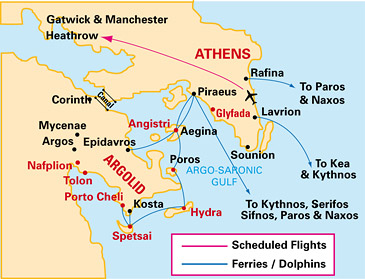
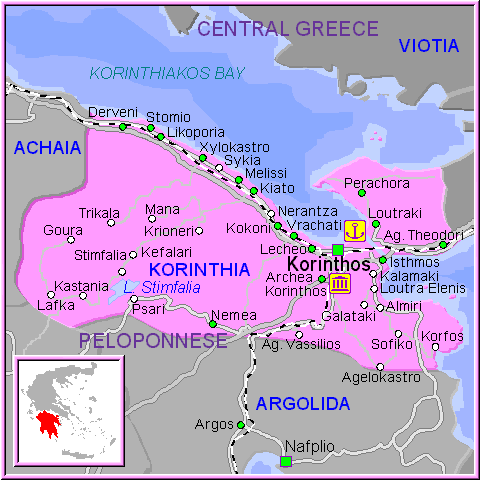
Now that I’m back in Athens, it seems that I must give a brief report on Trip 4, and do it soon, since our seminars (i.e. ‘course work’) start tomorrow, bright and early. The last trip, which ended on Friday, took us to the Argolid and the Corinthia. Since we were staying mostly in two regions, we stayed in only two hotels; the impact this stability had on our happiness and enthusiasm was, I think, palpable.

Nafplio was, as per usual, fantastic. I’d spent six weeks there a few summers back working at the Argive Heraion, and when I was there, appreciating the view of the bay from my balcony, I had no inkling of how fortunate I really was. Now I’ve been around Greece just a bit, and Nafplio has risen in my esteem to a glowing shiny height equivalent to the Palamidi at night.

The Palamidi fortress, from Nafplio's main square.

It is also the birthplace of Beast Cat, who emigrated back to America with me 3 ½ years ago.

Beast Cat's jealously guarded territory: the terrace of Rooms Bekas.

I remember our five days in Nafplio as peaceful, content ones, although I also logically recall being cranky and annoyed on multiple occasions. But all those moments seem to leech away in the happy haze of long dinners outside, charming streets and nightly gelato. I believe there might have been some Bronze Age stuff, too, probably?

The welcoming committee at the Corinth Dig House.

The second part of our trip was based in Corinth; our guide on Trip 4 was Guy Sanders, the director of the Corinth excavations, tall, rangy, constantly smoking. His trip was marked by long morning hikes, inexplicable British slang, and a general feeling of laid-back-ed-ness.

Guy Sanders, an enthusiastic fan of geology. We definitely heard a great deal about marl, and jurassic limestone, and even on one occasion about what happens when a married super-continent decides to get a divorce. Here, it's volcanic rock from Melos.

When he showed us around Corinth, I had the distinct feeling that he was showing us around his backyard. Of course, he literally did show us his backyard, where he had built an experimental kiln; his two dogs even welcomed us and watched us go (mournfully) each day at the dig house. Corinth had a home-y and historical feel, perhaps because of Guy’s long experience with the area and his reminiscences, as well as the tight connection between ancient Corinth and the American School.

The homemade kiln, firing clay at 700 degrees since, well, since I don't remember.

In fact, the School began excavating at Corinth in 1896 and has been doing so ever since, minus breaks during the World Wars. The work there is intimately tied to the Regular Year Program, since in the Spring Quarter, Regular Members excavate there for a number of weeks and have been doing so for decades. The staff working in Corinth was fantastic to us: every day we ate lunch until bursting at the Corinth dig house, we took long tours in the excavation storerooms, and were treated to lectures in the living room.


In the dig house, Nancy Bookidis lectures on the Sanctuary of Demeter and Kore.

As I said, history is strong at the Corinth excavations, more so, I think, than in Athens at the School. I didn’t have to ask quite so many questions to get quite so many good stories. Nancy Bookidis, Assistant Director Emerita, had some great ones about her time as a Regular Member, told with Ron Stroud over double helpings of pastichio in the dig house. Apparently, our whining about the necessity of lunch breaks is the whining of the spoiled; in Nancy’s year, as in all the years before, every lunch was a picnic lunch, and the acquisition of food was handed out to a handful of Members (the women). Nancy described getting up at 5am to search for a central market that would supply enough food for 30 people, and then, at lunch, having to deal with the guys complaining that she wasn’t slicing bread fast enough. She also described not being able to wear pants in deference to Greek custom, and hiking through the absolutely deadly Greek underbrush wearing a skirt and socks pulled up as high as they could go, yet unable to protect against the thorns.

Ron Stroud and the wall of photos, just after pointing out a picture of his wife from the 1960s.

One of my favorite parts about Corinth was the wall of photos, packed with pictures going back to the turn of the 20th century. The Peirene Fountain in the city of Corinth, for example, was prominent in the photographs, excavated back under Bert Hodge Hill in the early 1900s.

Framed photo of Bert Hodge Hill's excavations at the Peirene Fountain.

There is also a picture of one of the School’s archaeological superstars, Carl Blegen, just after having climbed out of the subterranean tunnels of the Fountain, utterly covered in mud, beaming.
Swift and Blegen, mud besplattered. Make sure to note what a looker Carl Blegen was.

For years the young man next to him was unidentified until rumor got round and the man sent a letter to clear up the mystery: Emerson Swift.
Swift's letter from 1971, describing their experience, taped to the back of the picture frame.

Since then, others have searched the tunnels as well, better equipped, I think, then Swift and Blegen, who described tunnels so full of water and mud that they had to hold their mouths right up to the very tunnel roof in order to get oxygen.


It’s a bit cleaner in our day, but at least we can add another photo to the Peirene palimpsest accumulating at Corinth; I’ll make sure to tell the story of my first visit to all the little snot-nosed Regular Members when I’m 80, in Loring, over pastichio.

Us at the Peirene Fountain, following in the footsteps of 113 years worth of ASCSA members.

Thursday, September 11, 2008

Loring Hall: The Hostel for Women Problem

Like all the Regular Members before me for the last 79 years, I live in Loring Hall.

Loring is the American School’s dorm, situated directly across the street from the School building itself. My room is on the upper floor at the top of the stairs, next to a book shelf which has been collecting paperbacks for more years then I’ve been alive. I’ve been wondering what famous archaeologists slept in my room back in their Regular Year days, so I’d thought I’d take a look at the history of Loring.

The upper floor of Loring, these days, is all female. As it turns out, it has always been that way, since the building first opened its doors in 1929. But even before that, the ground on which Loring sits was destined for the women students of the School. Just before WW I wreaked such havoc on the School’s goings-on, the topic of sleeping quarters for women came up among the Managing Committee. Someone proposed that a Women’s Hostel be built, so a committee was established to find the land on which to build it. The next year, 1916, saw the plot directly across from the School come up for sale (conveniently enough). Another committee was established to raise some funds; it was headed by a women, one Francis G. Allison of Brown University, who worked on Lucian in her spare time. By seeking funds from the women’s colleges in the States, she was able to get the money in record time, while also attracting the help of Bryn Mawr’s former president, Martha Carey Thomas.

Carey Thomas had been president of Bryn Mawr for a number of years before retiring, and she was known for her autocratic leadership style (which had actually gotten her in some trouble). In other words, she got stuff done. It seems that she became one of the driving forces behind the hostel project, yet the actual purchase of the land ran into some road blocks for several years because of ‘contractual problems.’ I’m interested to find out what those problems were, but I’ll have to save that for another day. After they got the land, it became harder to raise the money for the actual building.

By 1922, the situation was coming to a head; the School’s women had up to this point rented private residences and were not permitted to live on the School grounds. With the progress of WWI, Athens was inundated with refugees, making it nearly impossible for the women to continue finding residences. It was decided by the Managing Committee that, during the next year, the women would live in the main School building with the men; following ‘considerable discussion,’ it was implied that this was a very temporary solution which should be rectified, post haste.

In 1928, Carey Thomas and her fellow women decided to try to raise tons of money to make the Women’s Hostel a dorm for ALL university women in Athens; no men would be allowed except in the dining room. Right as this was happening, however, the International Education Board decided, hey, why don’t we donate over $100,000 dollars so the School can build a dorm for all sexes? And just like that, all the work done for over 10 years to get a Women’s Hostel up and running was thrown out the window. It was obviously a great thing for the school, but I imagine the frustration and disappointment that accompanied this very generous offer.
M. Carey Thomas and William Caleb Loring

Suddenly Carey Thomas was no longer in charge; Judge Loring himself came in from the Board of Trustees to head the new committee. He must have had a position of considerable authority and a penchant for raising enormous sums of money.
Loring Hall

In 1929, it was done; Loring had gotten the job done fast, and had even donated some money. The students moved in during July, and the structure was named William Caleb Loring Hall. The women, instead of getting their own hostel, got the rooms above the kitchen, laundry facilities, dining room and game room. In the end it worked out well (I much prefer to be in the main building, where I get wireless!), but I wonder how they felt at the time.
"..an airy (but well heated) dining room..."

Thus I’m living in a room designed for those women in the late ‘20s and furnished by a $5,000 grant (!) during the Great Depression, although I’m not sure how many of those original furnishings survive at this time.


Laundry facilities, donated by the 1984 Alumni Association
And so the American School's dorm was constructed and has served generations of students and archaeologists. It's been said that for most Members of the School, Loring is really and truly a second home. I'd wager that every former Member remembers exactly what room they were in that first year they spent at the school.
(Thanks to L. Lord's A history of the American School of Classical Studies at Athens, 1882-1942 .)