Saturday, June 1, 2013

Plants as historical artifacts

When I was at the American school a few years back, Harriet Blitzer gave us a fascinating talk about olive trees and how their shape and growth patterns reveal some fascinating data about their life history and the historical circumstances of the trees' immediate surroundings. Much as the matrix of an ancient person's bones tell us whether they struggled as a laborer or suffered with diseases, the shape of the branches, the thickness of the growth, and the form of the trunk explain the presence or absence of human activity, erosion, natural competition, and so on. Plants serve as historical records, evidence of events and site formation.


This bush is likewise a historical artifact, although in its case it is an heirloom of sorts. It's a cherry hedge and sits outside my window at my aunt and uncle's house. But what you might not recognize at first glance is the fact that this little bush is actually 50 years old. According to the oral history shared by Joanne Kelly (née Rask), this bush was planted by her mother, Myrtle Rask (née Sirl), my grandmother. When the family moved to the house in the 1950s, she established a garden at its south edge. A long cherry hedge, situated in a L-shape, served as a fence for Myrtle's garden.

 The back of the house in the 1950s. Note the hedge on the left side, cordoning off an area for the garden.

Now the garden is long gone, but a little bit of the hedge still remains.

At OSU, there is a historic plane tree near my old building with a sign proudly proclaiming that it stood, a young teenage plane tree, when the US Constitution was being signed. Our bush was proudly standing when my dad joined the Boy Scouts and when he went on to Vietnam, when my cousins took apart and rebuilt their first engine, when my aunt finally retired from teaching. Who needs a constitution tree, right?

May 1961: (Uncle) Tim Rask works in the garden, surrounded by the cherry hedge.
 

Saturday, May 25, 2013

Back

 
Lake Worth, Kelly-Rask Homestead, est. 1952

Back in Lake Worth for some much needed down time before the excavation season begins. Back online with this blog, which has been closed for about the last year and a half, thanks to dissertations and classes.

It's nice to be back :)

Monday, February 7, 2011

Even More Graves of Archaeologists

Way back in the day when I was a more dedicated blogger, I did some posts about the graves of archaeologists (here and here and here [not an archaeologist, but whatever]). I always meant to follow up with some additional posts but, as happens, I never got around to it. I still think it's an interesting project, though, so I thought it would be worth returning to.

Here we go:

John Pendlebury's story has reached truly historic and heroic proportions. He was a British archaeologist associated with the British School next door to the American School. He worked at two of the most famous Mediterranean excavations EVAH, Tell el-Amarna in Egypt and Knossos on Crete. During WWII, he stayed on Crete as a British spy and in so doing won the hearts of Crete's entire population. The story goes that nobody on Crete knew who the hell Sir Arthur Evans was, but they all knew Pendlebury. He was wounded and captured during the German assault on Crete. The Germans stood him up against a cottage wall and shot him through the head. He's buried at the Commonwealth cemetery at Souda Bay.


Like Pendlebury, George Mylonas had his own war story. A soldier during the Greco-Turkish War (1919-1922), he was captured as a POW. His Smyrna-based family lost virtually everything in the war, but he went on to become a prominent archaeologist in Greece. He was a student of David Robinson at Olynthus and in the late '20s he even served as the Bursar of the American School in Athens. He's most famous for directing the excavations at Mycenae - he's the guy who led the excavation of Grave Circle B. He's buried down the hill from Mycenae in the same little cemetery as Humpfrey Payne. Like the Blegen's grave in the First Cemetery in Athens, Mylonas' sarcophagus is decked out in a way that links him to the ancient peoples he studied - the spiral-y things running along the bottom are a decorative motif visible in Mycenean art. (I'd like to thank Vassiliki Pliatsika for providing me with the pictures of Mylonas' grave. Thanks!)

And just as a quick note, there are many more graves of archaeologists and classicists in the First Cemetery that need to be documented. For example, if you feel like stopping by, visit these people (courtesy of Dan Leon):

Arnold Hugh Martin Jones (1904-1970) - Author of "The Later Roman Empire, 284-602" and apparently popular with all the Late Antiquity peeps, even if he wasn't big on archaeology. He had a heart-attack on a boat on his way to deliver a series of lectures in Thessaloniki.

Adolf Furtwaengler [whom I've already noted - but it doesn't hurt to give him further props] (1853-1907) - Wrote a dissertation on vase painting, was instrumental in the development of the 'comparative method,' participated in the excavations at Olympia, and co-authored the first corpus of pottery finds ever (Mykenische Thongefaesse, from Aegina).  He helped to come up with the idea of using pottery and stratigraphy to create a chronology.  He wrote a bunch of stuff on vase painting and sculpture, ran a few museums and digs, published a monograph on Aegina, but contracted dysentery there and died.

Gregory Vlastos (1907-1991) - Possibly the Gregory Vlastos who published widely on pre-Socratic, Socratic, and Platonic philosophy and is credited by some with bringing about a renewed interest in Plato in the philosophical community.

Saturday, October 23, 2010

Why my niece and nephew are getting this

The Book of Kells is considered Ireland's most precious treasure.


Looking at it really does make the eyeballs bleed, in the best way possible. When they talk about works of art making people cry, instead of thinking of about Michaelangelo, I think of the nameless scribes who made the Book of Kells.


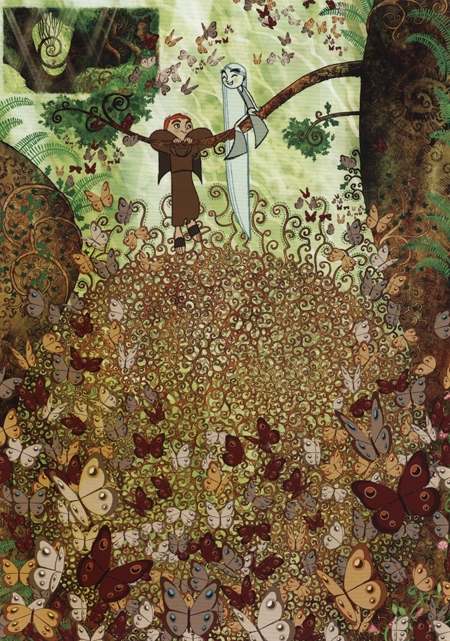
Last year an animated movie was released called The Secret of Kells. It relates a fictional story about the making of the book, full of little details aimed to please Medievalists and book lovers every where. For example, in the 8th century an Irish scribe wrote a poem about himself and his little cat Pangur Bán. The little cat in the movie is named, of course, Pangur Bán.

Anyhoo, the animation is jaw-dropping. Absolutely gorgeous. Most interesting of all, the animation is inspired by the art in the Book of Kells. It is at times ornate, rich, with jewel-like detail.


My favorite bits, though, are the bits that use Medieval approaches to depth; the landscapes are flattened, linear, objects and buildings are shown from multiple perspectives at the same time (e.g., from the side and from above).


Like Medieval art, the movie avoids 'true' single-point perspective. Seeing it was a great reminder of the many ways that images can tell stories; the Western ideas of perspective and naturalism are not our only option!

Plus, the movie was a love story written for a book, a book that loved images as much as it loved words. And that's why my niece and nephew are getting it. The movie, that is.

Wednesday, October 20, 2010

When does memory become history?

And by history, I mean the kind that people put in museums. How long does it take, and how long should it take, for museums to start educating people about certain events?

There's obviously a whole shebang of reasons that a particular subject becomes the focus of a museum; the social and political influences are too numerous to name. But, the last time I was in Greece and Italy there was one museum that I wanted to go to that just did not exist: the World War II museum.

At some places in Greece, the history of WWII was more apparent and alive in local legend than in others. Crete's a good example, where the German attacks left behind a truely staggering mythology, complete with gun-toting grannies and knife-wielding civilians. Not to mention a number of memorial cemeteries.

The grave of legendary archaeologist, spy and adventurer John Pendlebury, located at the Commonwealth War Graves Commission Cemetery at Souda Bay.


While I was in Italy there were a good number of WWII memorials and the events of the war were fairly easy to learn about if you knew where to look and who to ask. They also turned up in unexpected places:


The amazing shrine of Father Marcello Morgante in the crypt of the cathedral in Ascoli Piceno features a series of mosaics commemorating his life. One of them shows the priest and other locals giving aid to British and American escaped prisoners of war.

I reckon that most Americans don't know about the two gigantic war cemeteries that our government pays to keep meticuliously groomed outside of Rome and Florence.

When I visited this summer, a gregarious guard at the cemetery in Florence said that of the 200 people to show up that day, only three (my party) were Americans. That was a bit sobering, although if it weren't for the Marine in my midst I wouldn't have known about the site either.


At what point will the memorials give way to museums, I wonder?

Friday, September 24, 2010

Interview with Ron Stroud Part 1.2

A while back I posted the first part of my on-going interview with Ron Stroud, in honor of the Regular Year Members of 1959-60. Unfortunately, I left out part of it! So here is the last fascinating tidbit associated with the first part of our interview. It's short but definitely sweet. I asked Ron how he traveled to Greece and what it was like - plane, train, what? He answered:

"I traveled from New York to Athens in August 1959 on the Greek liner, Queen Frederiki.

The Queen Frederica in 1967. For an idea of what the experience would have been like, check out this awesome video.

Pierre MacKay and the other Fulbrighters came on the other Greek liner, the Olympia. Also on the Frederiki were fellow-students Bill Wyatt, and his wife Sandra, Jim Wiseman (his wife Lucy came later), Patrick Henry and possibly one or two others. Fellow passengers were the new Director of Athens College, Dr. Rice and his wife, and the Greek poet, Athanasios Maskelaris, from whom I had Modern Greek lessons on board. The trip took 14 days and we all got the false impression that the long journey was almost over as soon as we cleared Gibraltar, but then we stopped in Barcelona, Palermo (where WW II bombing was still very evident), Naples, and Messina and it seemed to take forever to get to Peiraieus.

I was in a cabin in the very bottom of the ship with five old Greek men who had recently retired and were returning to their villages to live off the proceeds of their US Social Security. I was the only non-Greek at our table for eight, which was provided for lunch and dinner with a large flagon of very bitter retsina. The menu for lunch and dinner was printed in Greek and English and I still have one as a souvenir.

Queen Frederica menu from the 1960s.

We had a Greek orchestra, Greek dances, and Greek movies every evening; I remember Melina Mercouri in "Stella." I relieved the boredom of the journey by a shipboard romance with a young American woman who was sailing to join her parents in Athens, where her father worked for the CIA, and she was going to join the US Economic Mission. The Truman plan was still very active in Greece and the US Mission had taken over the huge city block occupied by the Tameion Building, just off Syntagma, and containing the swish watering hole Zonars, where many Americans hung out. The US Embassy was at Vasilissis Sophias and Herodes Atticus, catty-corner from the Benaki Museum and across the street from the headquarters of the Evzones.

Greece was not in sight on the eve of our arrival but I was too excited to sleep and around 3.00 a.m. went down the hall outside our cabin to where a member of the crew was standing smoking next to a large open door. The sea was rushing by and on the horizon barely visible was the outline of a mountain. "Ellada[Greece]" he said laconically. It was Cape Malea and he seemed as excited to be here as I was.

We were met at the dock in Peiraieus by Colin Edmonson, the Secretary of the School. The Secretary normally met arriving members of the School in those days. We had little baggage, because you had to go down to Customs to clear your belongings the next day, so Colin bundled us all into the School Land Rover, a venerable gray vehicle, with a large spare tire on the hood, that had been donated by Dr. George Miles of the American Numismatic Society, father of Mimsy Miles and future father-in-law of the future Director, James McCredie. It so happened that McCredie himself was there with Edmonson because they had been out on a topographic excursion with Arthur Steinberg. The reason I mention these three is that as we drove into Athens and the Acropolis loomed into sight, we all in the back seats were stretching our necks and uttering excited exclamations, while Edmonson, McCredie, and Steinberg merely drove by without looking. Hardened veterans."


The Parthenon in 1959. This amazing picture from here.

Wednesday, September 1, 2010

Good night, sweet trench

Alas, lovely trench PC 42's days have come to a close.


Actually, they came to a close at the beginning of August, but, well, I haven't quite got around to commemorating the trench's final moments.

In the end, PC 42 was excavated down to bedrock which revealed several walls and a good deal of construction evidence. We found a fair number of post-holes and cuttings in the bedrock and a lot of levelling fill.

Most of PC 42's scarps were a nightmare, thanks to tree trunks and the ancient dumped debris that makes sculpting scarps into vertical faces - 'like glass'- the bane of undergraduates.


On the last day of fieldwork, a tarp was laid in the trench and all the dirt we had removed during the season was dumped back in. This is called 'backfilling' and is done in order to protect the trench from the elements, as well as clandestinii (looters). Watching all that dirt go back in - well, it hurts the heart a little to see it done.

Backfilling at Poggio Colla in 2004.

It also hurts everywhere else a little, too. Actually, a lot. I'll be honest. Backfilling was the one day where the physical pain was so bad I wanted to cry. It was a nice reminder that age and decrepitude even conquers archaeologists.

Ultimately I did survive Backfill Day, though. So too did PC 42's students, who were total champs and made the season really spectacular.

Thanks, guys: Cassie, Kristen, Morgan, me, Sarah, Jack.

For now, PC 42 sits lonely upon its wooded hill, tree roots already weaseling down into the soft empty soil that has replaced its 2300 years of stratigraphy. The Mugello Valley is a quieter place, without the hoard of filthy American students stomping about in a fine impersonation of 'Pig Pen.' I went on to see a large part of Italy over the subsequent three weeks (more on this later), but in the end, the Mugello still holds pride of place as my favorite part of Italy. Mushroom hunters, wild boars and lightening storms just aren't the same anywhere else!

Me and the Mugello at dusk, as seen from the amazing restaurant 'Casa di Caccia.'