Monday, August 11, 2014

The season comes to an end


Another season comes to an end at Poggio Colla. 

Saturday, July 5, 2014

2014 Season, Here We Come

The new season at Poggio Colla is underway and we are back on top of the hill exploring the ancient Etruscan past. As usual, brambles overtook the site, but this time, we made the students help us remove them. Ha! Suckers.


We are finally finished unbackfilling two trenches, after days of picking, shoveling, and wheelbarrowing. PC 45 has been unveiled!


We broke ground in my old trench after leaving it abandoned last season. Interesting new info about the site's construction history has already been revealed and, for once, it makes sense. I am in stratigraphy heaven!

Wednesday, June 18, 2014

Lessons from Feral Cats, or My Year as the Cat Lady

This last year, while teaching at the University of Tennessee, I lived at a place that hosted a pre-existing feral cat colony of 20-30 beastlings. During the year, I therefore learned quite a bit about ferals; most of my neighbors had no desire to deal with the cats or feed them, and I couldn't stand strong against the cats' protruding ribs and desperate meows.

Policy nowadays with feral cats is ‘TNR, trap-neuter- release.’ Local feral cat groups will help by supplying traps and paying for the procedure at participating vets. I trapped and neutered the majority of the cats (with a little help from one kind neighbor, who took in a few herself). It’s a slow process, depending on how many traps one has available and how many spots the vets have open on their ‘feral fixin’ days.

Momma Cat, her kitties, and Yellow Cat, investigating the traps.

The other problem is that wild cats are prone to feline leukemia, a truly vicious disease that is spread through grooming and sniffing and sneezing on each other. It manifests in a wide variety of horrible ways, including pneumonia-like symptoms, stomach problems, or slow starvation. And so, after TNRing so many, I found two dead on my doorstep and five more had to be put down. It was a depressing and draining several months.

Then there was the problem that, the first few times I encountered a sick or injured kitty, I rushed it to the vet. I did not realize that various vets charge dramatically different prices for the same procedure. I learned to my intense frustration that one should ALWAYS call several vets to get price quotes before tearing down the road. One should also feel confident about refusing to pay for poor service. After Powell Animal Hospital mistook a loose baby tooth for a shattered tooth that HAD to be pulled immediately, only to discover on the operating table that it was actually a simple offering for the Kitty Tooth Fairy, I was still charged several hundred dollars for all the surgery expenses. Certainly I complained and asked them to reduce the price due to their ineptitude, but like a fool I still paid them. In the end, my first few months with the ferals cost me nearly $1500 that I could not afford.

The lesson? Feral cat groups actually have accounts set up with certain vets and they will help you in dire situations, so always call your feral contact person first!

It’s not all trials and tribulations, of course. As soon as I moved in, a momma cat with three kittens showed up and over the year I gentled them and turned them into perfect pets. Phantom went on to find a home at the Pet Smart Saturday Adoption Event. She is happy and healthy and has a family that adores her now.

Phantom, still in the wild.
Phantom’s Brother, who I contemplated naming Lover, Rake, or Mr. Darcy, stared boldly and deeply into your eyes while being petted. Alas, after losing all interest in playing with his sisters, dropping weight, and beginning to look fragile and creaky, I discovered he had leukemia and he had to be put down. I held him in my arms and wept the entire time.

His last sister is the ever-demanding, hilarious, and extremely energetic Mayhem. This kitty wants to play all the time and to my surprise, taught herself to play fetch. Whether it’s a bit of plastic or one of the crocheted ropes I made her, she loves nothing more than to go galloping after it and drag it back to you. She was the one I couldn't bear to give away. As an archaeologist involved in fieldwork overseas, the pet situation can be complicated. Mayhem will be spending the summer with my mother, where she is gamboling about, safe, full of food, and no longer a hollow-eyed feral cat.  

Mayhem, in October, napping.
                                     
Keep yourself educated about feral cats - why they can be good for neighborhoods, how you can build them winter shelters, and most importantly, how to control their population. Check the web for your local feral cat groups, or read these sites:                                                                                                                        

Education material from Alley Cat Allies

Feral Feline Friends in East Tennessee (w/o these ladies I would have been buried by my feral cat disasters)       

Friday, June 6, 2014

The excavation season begins

Things are picking up in the ancient Mediterranean field season. Many digs started in early May, in order to follow the summer schedule of universities on the semester system. I myself won't head over until the end of June.

If you'd like to keep up with some of the people I know (sort of) already working in Greece, here are some links:

Follow along with Kostis Korelis, who will be mapping tiny villages and houses in Greece (Objects-Buildings-Situations) Always interested in domestic architecture, Kostis will examine houses that still stand, as well as houses long gone (via archives). Not only will you find great insights on this blog, but you'll also get to see Kostis' wonderful drawings and sketches. Additionally, a Poggio Colla student is representin' on the house project, our very own Joel Naiman!

Then there is Bill Caraher's The Archaeology of the Mediterranean (recently moved to Wordpress from here), which follows Bill's fieldwork with students in the Argolid. It includes some beautiful pictures and discussion of archaeological methodologies, such as surveys.

For pictures of Roman villas destroyed by Vesuvius, follow archaeologists such as Angela Trentacoste on the Oplontis Project Facebook page.

Thursday, May 1, 2014

What to Bring to Poggio Colla

Every year a list goes out that advises the Poggio Colla Archaeological Field School students what to bring. I think, now that I am in my fifth year with the project, I am become wise in the ways of the Mugello Valley (or as scientists will correct you, the Basin). It behooves me, then, to add some to that advice and create a  list of my own. Let me share my wisdom, or more plainly, the list that the ever illustrious Trench NW 6 helped me make last summer.

1)  Gloves. The Right Kind. Every year I am pleased to see that eager students bring a pair of gloves, but saddened to find that they’re the wrong kind of gloves, the kind that won’t last the season and sometimes even the week. Don’t get me wrong, no one brings lacey numbers fit for a Regency Ball, but usually the big mistake in evidence is the purchase of gardening gloves.

Ahem. Let me say first that archaeology is not gardening. Archaeology is heavy manual labor. Fabric gloves and those rubbery doodads disintegrate with a quickness, especially in a woodland environment. So, in the interest of your daily happiness, be sure to bring true work gloves, leather being the best sort, in my opinion. Because I have tiny hands, I prefer thin leather gloves which also allow me to ‘feel’ the soil and artifacts being handled (thick heavy-duty work gloves hinder that oh-so-vital sense of touch so important in fieldwork). If you would like something softer that won’t shred your hands but will still hold up, go for something like this, which is what I use:


You might get a hole in the finger, but generally they hold up pretty well. 

2) Clippers. You’ll be asked to bring a pair of clippers, something that surprised me when I first came to PC, thanks to my background in archaeological contexts that might include four roots in an entire trench. At PC, you will be digging in a woodland environment and there will be roots, roots, roots everywhere. This leads to the clipper problem, because the standard hand clippers that you can buy at Lowes and Target just won’t cut it. (See what I did there?) They’ll break or jam and will generally be useless. Indeed, the garage at Guardia the Dig House is overflowing with buckets of cast-off clippers, none of which work. So invest in a strong, good-quality pair of hand clippers and prepare to guard them with your life. To be honest, in my dream world, everyone would also bring their own personal Cyndi Laupers (aka Loppers, but ha, ‘tis only a fantasy.)

3) Trowel. Duh, this is archaeology and trowels are important. Be forewarned, however, that hardware stores mostly carry brick laying trowels, which are too big when it comes to the blade and include handles uncomfortably large for smaller hands. Since the trowel will become an extension of your limb, it wouldn't hurt to order something from Marshalltown. I use a Battiferro.

My first season working in Italy I was thrown off to find that Italian archaeologists don’t use trigonos. The trigono (‘triangle’) is used as often as the trowel at Greek sites. I always liked it because it doesn’t put the same pressure on your wrist and (in my imagination at least) eases trowel tendinitis. So this year I am bringing my own trigono, too.

More commonly known as the 'shavehook.'

4) Mugello Microclimate Appropriate Clothes. I froze during my first season at Poggio Colla. I was a Greek archaeologist, used to islands in the Cyclades and hot breezy days in Naufplio. The thick opaque mist encasing my house when I awoke in 2010 was not at all what I was expecting, and not at all within the bounds of appropriate excavating weather, in my experience, thank you very much. With my t-shirts and gym shorts and single hoody, I felt like I was an extra in Frozen. But now I am aware that the Mugello Valley is far north of those baking Mediterranean sites I so adored and in fact exists within its own microclimate. This means that Poggio Colla can experience some searing hot days (as we saw in the drought-cracked summer of 2012) but it can also be surprisingly chilly and rainy.

For this reason I suggest: a pair of jeans and house pants for home, a pair of work pants for the site. Sweatshirts and hoodies for at-home and on-site. Jammies that are WARM, flannel and long-sleeved. I even bring one of those travel style down jackets from Target. This does not mean that at times you won’t be dying of heat stroke and wishing for a miu miu, but you’ll need to be prepared for a weather-pattern that varies significantly throughout the season.

5) A Mini Flashlight. Comes in handy, I promise, even on-site for the badger holes.

6) Dude, Granola Bars. You cannot buy granola bars cheaply in the Mugello, and I promise you will be hoping for easy snacks when you’re on-site. I bring a case of Cliff bars.

7)  Deodorant. Yes, yes, I know, I shouldn't have to tell you this. Due to the potential fine for overweight baggage, most travelers usually suggest forgoing your own shampoo and heavy bath products, since you can get them at the Coop (grocery store). But packing your own deodorant is a ‘must’ because in the Mugello the only kind of roll-on deodorant you can get is the wet kind. Ew, gross. Texturific in a bad way. (I just made that word up, btw.) Every summer there is a great deal of distress caused by the deodorant issue, so please, bring your own.

Note well, however. If you use a special personal product of some sort, like a face cream or what have you, keep in mind that you won’t be able to buy it in the Mugello and you are best to bring it with you. (Heavy duty hand cream, for example. This year I am actually bringing this, for archaeology hands.) All the normal stuff will be available in Vicchio, but if a lack of Chanel no. 5 will make you cry, bring it with you.

8) Sunscreen and Bug Spray. As a follow up to the last point, you can buy both of these at the Coop, but the bug spray will include 9 kinds of deet and the sunscreen will be a paraben colony. Which is fine, if you’re into that. If you have favorite all-natural products, you know what to do.

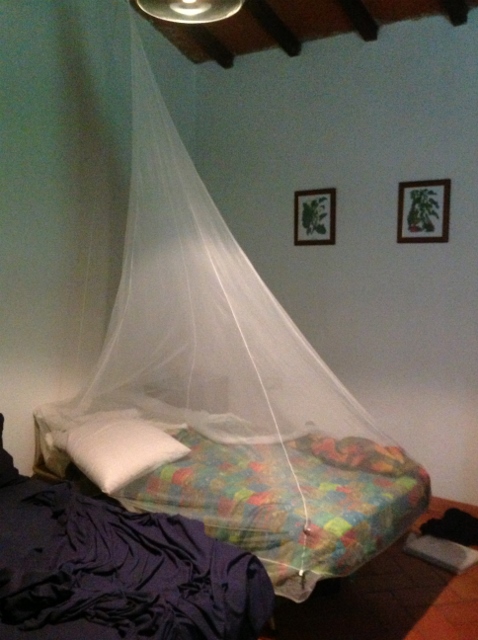
9) Mosquito Net.  Note Angela the Bone Lady’s nest from last year.


On that first night, as she acrobatically maneuvered ropes over the ceiling beams and I read my Kindle in bed, I chuckled at (what I thought to be) her over-zealousness. Two days later I was wrong, and wished I could steal her mosquito-free nest. This will be even more important in Vigna the Student House, where people come and go, doors open and close in the night, and mosquitoes thrive as the unconquered fifth column. I almost suggest bringing a second mosquito net so you can duct tape it over your window and doorway!

10) Ear plugs. Crucial. I find these useful because the mosquitoes flying around my head can’t faze me. But more importantly, other people snore. Or stay up late. When Sleep and I have a date, silence must reign.

11) Something For the Pain. And there will be pain. This is archaeology after all. You think Indiana Jones wasn't sore and stiff after a busy day destroying Nazis and crushing antiquities? This year I am trying out this product, on the advice of my physical therapist:

You'll know if it works, depending on how much I groan and grumble about my old person's body.

Wednesday, January 1, 2014

Teaching Mondrian and 'The Matrix'


Abstract art, so they say, hasn't been well received by the general public in the United States since the 1913 Armory Show in New York. As it was presenting the likes of Picasso, Duchamp, and Cezanne, the public was not especially overjoyed by the contents. Since then, many Americans still find abstract art to be baffling, offensive, and most frequently, something of a joke.

I get a somewhat similar reaction when teaching 20th century abstract art in the art history survey. As an art that was more interested in high concepts rather than accessibility, it can be a difficult subject to make interesting for art n00bs.

That's why I find that Mondrian is actually my favorite of the abstract artists to teach in class. He was dogmatic, inflexible, and I think rather inflexible in the end, but for me he is a perfect teaching example.


Mondrian’s art was rooted in philosophy. He was interested in Theosophy, Blavatsky, and Schoenmaekers, believing that beneath the deceptive world around us lay the hidden structure of the universe. That underlying universal truth found expression in mathematics. Think, for example, of the inevitable expressions of math in nature: the Fibonacci sequence, the Golden ratio, hidden spirals in conch shells. It now appears that even hunter-gathers participate in the Lévy walk, a mathematical pattern of movement observed in bees and sharks.

Especially important for Schoenmaekers was the visual contemplation of this hidden cosmic reality (according to White (p. 25), a result of Shoenmaekers’ background as a Catholic priest combating Protestant ‘inwardness’). Artists could access this hidden mathematical structure of the universe using that oh-so-very visual branch of math, geometry. And so Mondrian stuck with squares and rectangles, lines, and, of course, the three primary colors (the subatomic particles of color, if you will). Naturalism in painting was deceptive, a lie, and it should be the goal of artists to reveal the true cosmos that exists beneath the world around us and perpetuate that truth for others.

This is some pretty heavy stuff  for an introductory class, but I can’t help but get excited about it because it relates to my research interest in iconographic theory. Yet, how to easily get across to students the point that Mondrian paints the core elements of the universe that lay beyond the lying natural world that lies?

For me, and probably anyone born after the creation of Star Trek TNG’s holodeck, a parallel between virtual reality and Mondrian's world quickly comes to mind. This is most helpfully articulated by ‘The Matrix.’ In that movie, humans are trapped in a fake world, a world made of lies that they don’t see and cannot recognize. The entire world is a computer's creation, while humans happily putter along, oblivious.


But Neo, like Mondrian, can access the hidden structure of the world, he can ‘see’ what lies beneath. And for Neo, is it mathematics? 


No, it’s code. But, of course, what is code? Numbers. Zeros and ones.

Like Neo, Mondrian wants to reveal the hidden reality to all, to make it clear as day. But alas, Mondrian finds that cosmic structure to be beautiful and wants to celebrate it, while Neo wants to destroy it. Because in ‘The Matrix,’ that mathematical structure of the universe is just another level of deception.

Nevertheless. ‘The Matrix’ and Mondrian. It’s still a pretty fun comparison – if one were to break down the visual world into its base code, the fundamentals of visual programming, wouldn’t it just be lines, shapes, and primary colors?


Who knew Keanu Reeves could help me teach abstract art?

Friday, December 6, 2013

Here Lies Bonita, UTK Pup

Before the summer began and Poggio Colla's excavation became my primary blogging topic, I was engaged in a mini-project about what I dubbed 'heirloom archaeology.' This referred to locally significant objects in a domestic structure inhabited for over 60 years by my family. When it came to the blog, I never quite made it inside the house, mostly focusing on historically interesting objects outside in the yard, such as plantsreligious images, and tools.

There is one class of items that I did not address, however, yet an emotional and archaeologically significant one: sixty years worth of pets. Most recently Tigger, after bravely falling in battle against stray dogs, joined his predecessors in the garden. My aunt and uncle's house is not unusual in this regard, and I recently came across an unexpected example here at UTK.

I should note first that it's only been in recent years that theorists have begun to reconsider the common divide between mortuary and domestic archaeology. While cemeteries were often separated out from living areas (the tombs located outside ancient city gates being illustrative examples), ever since Jericho bodies have been buried within houses. Indeed, sometimes they ARE houses. Kostis Kourelis, for example, conceptualized the Byzantine house as one constructed not just of harder architectural materials, but one built from the organic materials of flesh, bone, and burials.The living and the lost inhabit the same space in the archaeological record far more frequently than previously recognized.

I've been thinking about mortuary archaeology lately thanks to UTK's campus, which provides several examples of a rather thought-provoking nature. First, there's the Woodland-era Native American burial mound in the UT gardens, which might date back to the 7th c. CE. Then there is the Body Farm with its in-situ remains studied by students working in forensic anthropology, together with over 2,500 human skeletons stored under the football stadium in the anthro department.

And then there is the modern burial of that domestic pet next to the library, in what used to be the back garden of the Tyson family's home. The Neoclassical ('Colonial Classic') Tyson House is now part of the campus' office building collection. No Tysons live in it any longer and the six acres of their luxurious property, complete with a ballroom for their daughter's 1913 debut, has in the hundred years since its construction been swallowed up by the campus. That daughter Isabella had a puppy who, supposedly, her father brought home to her from a military stint in Puerto Rico. Named Bonita, the puppy would be lovingly interred in a back garden, much like pets today.

The former back garden with the back of the yellow Tyson House.

Little Bonita's grave would be attached to the deed when Isabella sold the house in the 30s, with the result that all future owners must leave it inviolate. My first thought on learning about little Bonita's spot was that it seems like a great comparative example for teachers covering ancient sanctuaries and abatons. The beautiful back garden of the Tyson home, where the city elite wandered at the beginning of the last century, is now a parking lot. A parking lot with this strange thing under a shady tree:

Here lies Bonita.

There's no inscription, there's no image, no marker with an Ode to Puppies, flowering bushes, red ferns, or other such clues as to what lies beneath. There is nothing whatsoever to indicate to the passing students that such an interesting (and rather touching) remnant of history rests here, on their path to Starbucks.

Just a boundary marker and a blank stone. I have to say its a bit strange to me that this is the case, especially at a university with a mascot that's a dog! If nothing else, it's certainly a reminder about memory, mortuary archaeology, and how easy it is to forget.

Sunday, August 11, 2013

So what did we find? 2013 Edition

You may be wondering whatever happened at Poggio Colla this summer, since I failed to post any details during the season. Let me give you a quick run down then.

This season we did not excavate on top of the hill, but instead explored the north west slope. We did this in order to investigate the earlier Etruscan period (7th c. - 6th c. BCE), since we know there was a settlement somewhere on the slopes. This area has been heavily quarried  in recent centuries, with the result that the hillside has been dramatically reshaped, what with quarries, roads, work terraces, and so on. In my trench (NW 6), we got to investigate this activity in more detail because the bedrock cuttings that were our focus turned out to be part of a deep stone quarry.

Here's a view of the trench half-way through the season. Note the clear stratigraphy: behind Sam and outside the quarry you see a very yellowish soil, whereas next to her and inside the quarry you see extremely dark, rich organic forest debris soil. After the quarry was abandoned in the 19th c., it sat open in the forest and collected run-off, branches, acorns, leaves, and so on, all of which turned into a dirt that any gardener would be ecstatic to put into their flower beds.


Of course, floating leaves were not the only thing to land inside the quarry. Part of the quarry walls collapsed inside, dumping stones of all sizes there for us to painfully remove during the excavation.

Phil Perkins contemplates a huge chunk of fallen bedrock before pick-axing out a break line as prep for the sledge hammer.
 

The stones actually mixed with a dense clay that held moisture to an extreme degree. This meant that not only did we have to sledgehammer bedrock, lift gigantic blocks, and bucket out loads of smaller stones, but we also had to deal with standing water.

Danielle and Peggy uncover a mini-pond in the trench, the first time we found standing water. Note that they are still eager and smiling.

This was a first for me. Yes, a few times in years past our contexts have gotten wet from the rain, but in this case, the water would bubble up as if coming from an underground spring whenever we removed certain stones. So we bailed and bailed bucket after bucket of grey water. At the end of each day we slunk out of the trench, covered in a foul smelling muck that dripped and plopped off of our clothing and tools. It felt a lot like excavating a well, but without the kick-ass finds and bones and egg shells.

Days later. We still hadn't found the bottom of the muck.

In the end, though, we did uncover a totally cool stone quarry, with all manner of cuts, tool marks, and niches.

Pretending it's a tomb, complete with sacrificial victims. If only.

Watching the dirt go back in on backfill day wasn't the coolest, but the students participated in the age-old archaeological tradition of throwing something in with the dirt to alert future diggers of our own activity. A few coins went in, but so too did this note:


Sunday, July 14, 2013

Poggio Colla update from the Mugello Valley

We're two weeks into the season here at Poggio Colla, and it's time to give a proper update on life here in Vicchio. This year we are not digging on our usual hilltop, but down on the slopes, in the wilds of the forest. I'm the trench supervisor for the exciting NW6 (Northwest Slope trench 6), a gigantic hole in the ground:


The hill of Poggio Colla is covered with similar large pits because it was the site of mining during the last few centuries. Our interest in this pit grew, however, once we (i.e., Phil) recognized some noteworthy tool marks bearing a strong resemblance to those on our Phase 2 structure on the hilltop.


Digging a pre-dug pit is certainly beneficial because most of the work has already been done.  The problem, on the other hand, is that the terrain can be rather dangerous to those both excavating the edges of the trench and those simply walking along its borders. My fingers are crossed that my students continue to have good balance.

Attempting to avoid sliding into the Great Pit of Carkoon and the gaping maw of a sarlacc. Click to embiggen and enjoy Kenzie's fierce archaeology face.

Excavation is a bit slower than I hoped, with some unpleasant stratigraphy thanks to the more recent (non-ancient) individuals who dug the pit. We may not have reached the fascinating ancient finds that we all know absolutely await us beneath, but we have uncovered some real treasures nonetheless. Take, for example, Amanda's find. As she was scraping with her trowel, she excitedly announced, "I've found something!! I found something! And it has writing! It says...."


"Genuine Leather. Swiss."

A leather watch band, sans watch. I wonder which person on the excavation staff lost a watch during the last twenty years, so that it could wash down the hill and be found in our trench. Also exciting was that orange object Amanda's holding: a plastic shotgun shell. Thanks to Christina, we know that the artifact must date to the 1930s and after, since it was at that time that ammo makers began to employ plastic. A nice comparison piece came from Gretchen's trench: a shotgun shell made of lead, which our weapon's expert Christina dates to the late 19th/early 20th century.

Off-site things are pretty mellow.

Our front yard.

The especially rainy spring delayed the entire growing season. As of yet, the fields of sunflowers are simply fields of green, full of teenage plants not yet ready to show off their cheery yellow faces. I'm still in the lovely little apartment named 'Cantina,' talking archaeology trash with my house mates and carefully rationing my last Casa del Prosciutto chocolate cake (the beloved restaurant doesn't open again until the beginning of August, since the family is on vacation).
 

My house-mate Phil, eating a snack.

My temporary roommate Angela rigged up this amazing mosquito-free nest, in which she cocooned herself each night. I wasn't bothered at first, since the mosquito population was down given the cool weather at the beginning of the season, but now that it's warmed up, I've received enough mosquito bites in unmentionable places that I'm wishing Angela had left me her valuable real estate.

Living in the Tuscan countryside continues to be something strangely magical. Beautiful views, mysterious bird calls in the night, and sunrise over the Appenine's. Every corner has a surprise, including our own backyard. Yesterday I walked past a tractor to find a peach tree, laden with picture perfect fruit. Hot damn! Thank you, Mugello.


 The peach tree. Nom nom.
 

Thursday, July 11, 2013

Rain of Maggots

Yes. You read that right.

Today in my trench two cicadas crawled out of some holes, still in their skin. Throughout the day the noise got louder and louder. We joked that by excavating our pit we'd released a plague.

It was funny until a storm rolled in, and it started raining maggots.

As in, the larvae of flies. Turns out they like to hang out in the forest, munching on leaves, and when an occasional thunderstorm comes along, they get washed out of the trees onto the heads and shoulders of unsuspecting students.

I'm sure you can imagine the results. Absolute shrieking, running about, flapping of hands, total hysteria and tears.

Want proof? Have a look at our ride home afterwards:


Monday, July 1, 2013

Baracca tales

Several years back, the excavation of Poggio Colla invested in an aluminum shed in order to protect its field tools from the elements. As an object made of metal sheets, it proved a major trial to carry the bits to the top of the hill where the tools are actually used. Since then, the shed has survived in varying states of preservation from year to year.

Until last year, of course, when we arrived to find the baracca ('hut') totally upended. It took us a week to make it past the horror and rebuild the abused structure. Much sweat and love went into the making of it and it became what I believe is the strongest version yet to grace the hill top. It even has a earthen embankment to keep it sturdy.

This year I was sure that the baracca would be in perfect condition, but alas for human intervention. Someone decided to use part of the roof to build what we think is a deer blind.


But the real problem is that we aren't even excavating on the hill this season, instead we're much further down the slope. So far down the slope that its way too far to carry tools back and forth every day. And thus we need a new baracca.

 
Gretchen and Phil tie up some supporting posts for the roof.
 
So we stole back the deer blind piece, the door, and one or two extra sheets that we had chucked in the woods. Add a few logs from the old sieve tripods, knot some ropes, and voila, a pseudo-baracca that will have to do for now.


Let's hope there aren't any thunderstorms in the near future, as the new shed seems a bit open. In fact, it's been noted that it looks more like a tiki bar and could use a few strategically placed coconuts and liquor bottles. So far it's working, though, so wish us luck!

Tuesday, June 25, 2013

Heirloom Archaeology: The Yard Edition Pt. 2, St. Francis

When I grew up, I assumed everyone had a St. Francis in their yard. We had one. Others in my family had one. When I asked who he was and why he was there, I was told that he protected and encouraged happy wildlife, that he would bring bounty to our little garden. He brought good luck to the yard and the squirrels and the morning doves.

Garden statues of holy figures are a tradition especially loved by Catholics. The concept and general idea behind them will be familiar to those studying ancient shrines for nymphs and other locally sacred beings.


In our family, St. Francis is the dominant garden statue and his presence can be traced to one particular image. It's the most 'sacred' in the family because its the oldest and it reaches back to the elder generation's childhood. It's been through hurricanes and moves, has been broken and reassembled, but somehow its still standing. It's the talismanic Athena Polias of the clan.

The statue of St. Francis has lived in the garden of the ancestral home's courtyard. The courtyard itself has gone through numerous changes over the years. Back in the day ('50s) there was even a palm tree in the middle.


This is where the grown ups sipped their cocktails: Myrtle Rask (my grandmother) and Anna Mae Sirl (great-grandmother).

But St. Francis was there, his toes in a bird bath, surveying his domain. He spent the years encouraging all the tropical plants to go wild, watching over the tiny lizards zipping across the patio, and providing a perch for song birds come to raid the bird feeder.


Analysis of the photographic evidence shows that nowadays St. Francis is in almost the exact same location, with some of the exact same plants still thriving under his protection.

St. Francis in 1958.


Best of all, he's still protecting the little animals :)


Friday, June 7, 2013

Heirloom Archaeology: The Yard Edition


In keeping with my continuing study of my aunt and uncle's Florida house, I've decided to start documenting some of the artifacts residing here. Indeed, here at the ancestral homestead one is surrounded by artifacts and heirlooms of a wide variety. Almost 60 years of habitation by the same family have resulted in an interesting conglomeration of objects. For (me) an archaeologist and lover of stories, it’s an ideal and happy situation, especially since its my family. Many of these artifacts would not be considered ‘heirlooms’ in the usual sense of the word. The term more often refers to  proudly displayed items that are ‘worth’ something, if not because of cost, than because of an aura endowed by story or legend. But I'll be calling my little project heirloom archaeology regardless.
In archaeological terms, 'heirloom' can be used to imply simply those objects “maintaining and reifying ties with the past” (D. H. Thomas 1976, 128). Commonly, archaeologists discuss heirlooms in terms of ancient chieftons and prestige. For example, in 1999 Lillios posited that “in chiefdoms, heirlooms serve to objectify memories and histories, acting as mnemonics to remind the living of their link to a distant, ancestral past. And because not all the living have equal access to that ancestral past, as heirlooms are typically valued objects that are not available or equally accessible to all members of a community, the possession, display, and transmission of heirlooms also differentiate the living and help to reify inherited social differences” (Lillios 1999, 236). That is, heirlooms are interesting because of their significance in society. In their Archaeologies of Memory, Alcock and Van Dyke likewise stress social memory.

These aren’t the heirlooms I’m interested in. Rather, I’m interested in 'memorable' objects  in a familial and domestic setting that are significant to the immediate inhabitants due to their life history and their link to the past, only. Not because of the social significance that they acquire outside of the domestic sphere. For the purposes of this blog, heirloom archaeology is a mash-up of familial archaeology and domestic archaeology on the micro scale.
 
Let’s start with this strange object that serves as part of the garden sculpture here. To me, it’s a mystery. Mechanical people might recognize it, however, as an engine head. Not just any engine head, but the engine head of the 1973 Volkswagon Bus that carried the Kelly family (my aunt, uncle, and 3 cousins) all over the country on camping trips, from Florida to Yellowstone. At some point, the engine broke, was fixed, broke again, and limped its way through the 70s and into the 80s. That is, it carried the family until 1981, when it finally gave up the ghost. That’s when it got turned into a piece of garden sculpture, rewarded for its loyalty in a spot of honor by the porch (instead of being thrown out like the engine from the 1965 Pontiac).
 
 
Another example is this object holding up the boat. Tools tend to be objects passed down from parents to children, with the result that many people have old-timey gear sitting around their garage or house, looking vintage and hip but usually serving no other purpose. This piece, however, is actually still at work. We can trace it to the Depression and  the 1930s, when Charlie Lloyd Kelly lived in Center, Mississippi with his Irish family (early settlers of Miss., arriving in the 1830s). C.J. used this mechanical jack until he died and it was passed down to his son, my Uncle Jim (Kelly). Today you can observe the depression-era jack still in use, slightly jerry-rigged, here in southern Florida.

These are a special kind of heirloom, then. Of little monetary value, these two artifacts make up the domestic material culture of the household. Ask the family about them, and you'll start a flood of talking, story-telling, reminiscing, and oral history. They're ugly and unremarkable and don't draw the eye. Yet, they're certainly significant links to the past that are part of the present life of the family home.
 

Saturday, June 1, 2013

Plants as historical artifacts

When I was at the American school a few years back, Harriet Blitzer gave us a fascinating talk about olive trees and how their shape and growth patterns reveal some fascinating data about their life history and the historical circumstances of the trees' immediate surroundings. Much as the matrix of an ancient person's bones tell us whether they struggled as a laborer or suffered with diseases, the shape of the branches, the thickness of the growth, and the form of the trunk explain the presence or absence of human activity, erosion, natural competition, and so on. Plants serve as historical records, evidence of events and site formation.


This bush is likewise a historical artifact, although in its case it is an heirloom of sorts. It's a cherry hedge and sits outside my window at my aunt and uncle's house. But what you might not recognize at first glance is the fact that this little bush is actually 50 years old. According to the oral history shared by Joanne Kelly (née Rask), this bush was planted by her mother, Myrtle Rask (née Sirl), my grandmother. When the family moved to the house in the 1950s, she established a garden at its south edge. A long cherry hedge, situated in a L-shape, served as a fence for Myrtle's garden.

 The back of the house in the 1950s. Note the hedge on the left side, cordoning off an area for the garden.

Now the garden is long gone, but a little bit of the hedge still remains.

At OSU, there is a historic plane tree near my old building with a sign proudly proclaiming that it stood, a young teenage plane tree, when the US Constitution was being signed. Our bush was proudly standing when my dad joined the Boy Scouts and when he went on to Vietnam, when my cousins took apart and rebuilt their first engine, when my aunt finally retired from teaching. Who needs a constitution tree, right?

May 1961: (Uncle) Tim Rask works in the garden, surrounded by the cherry hedge.
 

Saturday, May 25, 2013

Back

 
Lake Worth, Kelly-Rask Homestead, est. 1952

Back in Lake Worth for some much needed down time before the excavation season begins. Back online with this blog, which has been closed for about the last year and a half, thanks to dissertations and classes.

It's nice to be back :)

Monday, February 7, 2011

Even More Graves of Archaeologists

Way back in the day when I was a more dedicated blogger, I did some posts about the graves of archaeologists (here and here and here [not an archaeologist, but whatever]). I always meant to follow up with some additional posts but, as happens, I never got around to it. I still think it's an interesting project, though, so I thought it would be worth returning to.

Here we go:

John Pendlebury's story has reached truly historic and heroic proportions. He was a British archaeologist associated with the British School next door to the American School. He worked at two of the most famous Mediterranean excavations EVAH, Tell el-Amarna in Egypt and Knossos on Crete. During WWII, he stayed on Crete as a British spy and in so doing won the hearts of Crete's entire population. The story goes that nobody on Crete knew who the hell Sir Arthur Evans was, but they all knew Pendlebury. He was wounded and captured during the German assault on Crete. The Germans stood him up against a cottage wall and shot him through the head. He's buried at the Commonwealth cemetery at Souda Bay.


Like Pendlebury, George Mylonas had his own war story. A soldier during the Greco-Turkish War (1919-1922), he was captured as a POW. His Smyrna-based family lost virtually everything in the war, but he went on to become a prominent archaeologist in Greece. He was a student of David Robinson at Olynthus and in the late '20s he even served as the Bursar of the American School in Athens. He's most famous for directing the excavations at Mycenae - he's the guy who led the excavation of Grave Circle B. He's buried down the hill from Mycenae in the same little cemetery as Humpfrey Payne. Like the Blegen's grave in the First Cemetery in Athens, Mylonas' sarcophagus is decked out in a way that links him to the ancient peoples he studied - the spiral-y things running along the bottom are a decorative motif visible in Mycenean art. (I'd like to thank Vassiliki Pliatsika for providing me with the pictures of Mylonas' grave. Thanks!)

And just as a quick note, there are many more graves of archaeologists and classicists in the First Cemetery that need to be documented. For example, if you feel like stopping by, visit these people (courtesy of Dan Leon):

Arnold Hugh Martin Jones (1904-1970) - Author of "The Later Roman Empire, 284-602" and apparently popular with all the Late Antiquity peeps, even if he wasn't big on archaeology. He had a heart-attack on a boat on his way to deliver a series of lectures in Thessaloniki.

Adolf Furtwaengler [whom I've already noted - but it doesn't hurt to give him further props] (1853-1907) - Wrote a dissertation on vase painting, was instrumental in the development of the 'comparative method,' participated in the excavations at Olympia, and co-authored the first corpus of pottery finds ever (Mykenische Thongefaesse, from Aegina).  He helped to come up with the idea of using pottery and stratigraphy to create a chronology.  He wrote a bunch of stuff on vase painting and sculpture, ran a few museums and digs, published a monograph on Aegina, but contracted dysentery there and died.

Gregory Vlastos (1907-1991) - Possibly the Gregory Vlastos who published widely on pre-Socratic, Socratic, and Platonic philosophy and is credited by some with bringing about a renewed interest in Plato in the philosophical community.

Saturday, October 23, 2010

Why my niece and nephew are getting this

The Book of Kells is considered Ireland's most precious treasure.


Looking at it really does make the eyeballs bleed, in the best way possible. When they talk about works of art making people cry, instead of thinking of about Michaelangelo, I think of the nameless scribes who made the Book of Kells.


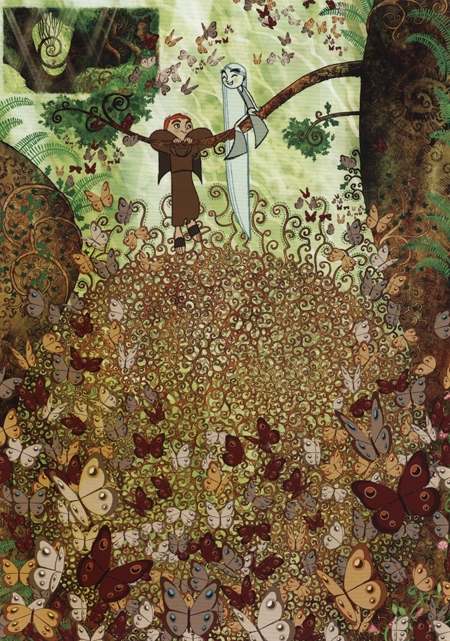
Last year an animated movie was released called The Secret of Kells. It relates a fictional story about the making of the book, full of little details aimed to please Medievalists and book lovers every where. For example, in the 8th century an Irish scribe wrote a poem about himself and his little cat Pangur Bán. The little cat in the movie is named, of course, Pangur Bán.

Anyhoo, the animation is jaw-dropping. Absolutely gorgeous. Most interesting of all, the animation is inspired by the art in the Book of Kells. It is at times ornate, rich, with jewel-like detail.


My favorite bits, though, are the bits that use Medieval approaches to depth; the landscapes are flattened, linear, objects and buildings are shown from multiple perspectives at the same time (e.g., from the side and from above).


Like Medieval art, the movie avoids 'true' single-point perspective. Seeing it was a great reminder of the many ways that images can tell stories; the Western ideas of perspective and naturalism are not our only option!

Plus, the movie was a love story written for a book, a book that loved images as much as it loved words. And that's why my niece and nephew are getting it. The movie, that is.